Articles | Volume 14, issue 2
https://doi.org/10.5194/gi-14-435-2025
© Author(s) 2025. This work is distributed under
the Creative Commons Attribution 4.0 License.
https://doi.org/10.5194/gi-14-435-2025
© Author(s) 2025. This work is distributed under
the Creative Commons Attribution 4.0 License.
Parametric design for soil gas flux system: a low-cost solution for continuous monitoring

Alex Naoki Asato Kobayashi
CORRESPONDING AUTHOR
Centre d'hydrogéologie et de géothermie (CHYN), Université de Neuchâtel, Rue Emile-Argand 11, Neuchâtel, Switzerland
Clément Roques
Centre d'hydrogéologie et de géothermie (CHYN), Université de Neuchâtel, Rue Emile-Argand 11, Neuchâtel, Switzerland
Daniel Hunkeler
Centre d'hydrogéologie et de géothermie (CHYN), Université de Neuchâtel, Rue Emile-Argand 11, Neuchâtel, Switzerland
Edward A. D. Mitchell
Laboratory of Soil Biodiversity, Université de Neuchâtel, Rue Emile-Argand 11, Neuchâtel, Switzerland
Robin Calisti
Laboratory of Soil Biodiversity, Université de Neuchâtel, Rue Emile-Argand 11, Neuchâtel, Switzerland
Philip Brunner
Centre d'hydrogéologie et de géothermie (CHYN), Université de Neuchâtel, Rue Emile-Argand 11, Neuchâtel, Switzerland
Related authors
No articles found.
Etienne Marti, Sarah Leray, and Clément Roques
Hydrol. Earth Syst. Sci., 29, 5665–5676, https://doi.org/10.5194/hess-29-5665-2025, https://doi.org/10.5194/hess-29-5665-2025, 2025
Short summary
Short summary
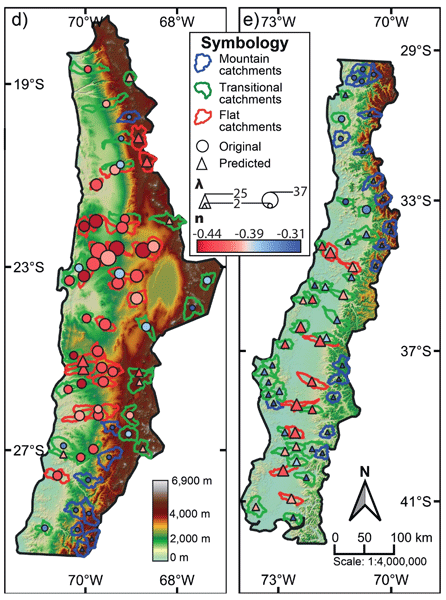
This study shows that the response of groundwater-dependent wetlands to recharge changes can be predicted from landform properties alone. Mountain catchments are less sensitive to recharge changes than flat ones, due to fewer but more persistent seepage areas. These results support a scalable approach to assessing wetland vulnerability to climate change, with practical implications for water resource management and conservation planning in diverse landscapes.
Sophie Erb, Matthieu Mulot, Alina Matei, and Edward A. D. Mitchell
Web Ecol., 25, 169–176, https://doi.org/10.5194/we-25-169-2025, https://doi.org/10.5194/we-25-169-2025, 2025
Short summary
Short summary
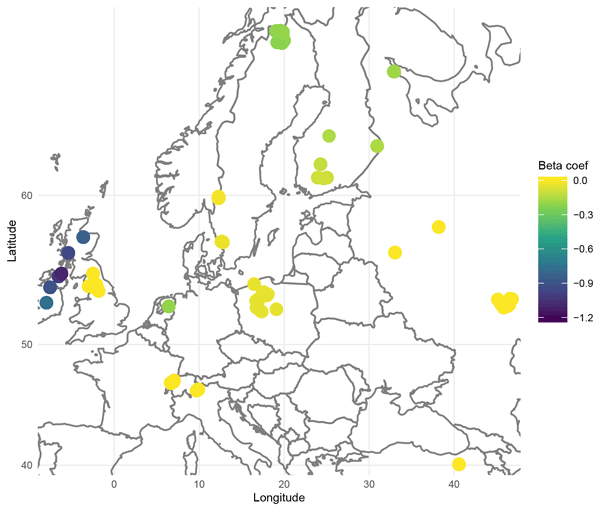
It is well known that the spatial distribution of micro-organisms is heterogeneous. Taking spatiality into account allows for better modelling of the environmental parameters that drive the distribution of living organisms. We show that geographically weighted models perform much better in reconstructing water table depth in peatlands based on testate amoeba communities. The method (R package) can be used for any application of a regression model in the case of heterogeneous spatial distribution.
Judith Eeckman, Brian De Grenus, Floreana Marie Miesen, James Thornton, Philip Brunner, and Nadav Peleg
Hydrol. Earth Syst. Sci., 29, 4093–4107, https://doi.org/10.5194/hess-29-4093-2025, https://doi.org/10.5194/hess-29-4093-2025, 2025
Short summary
Short summary
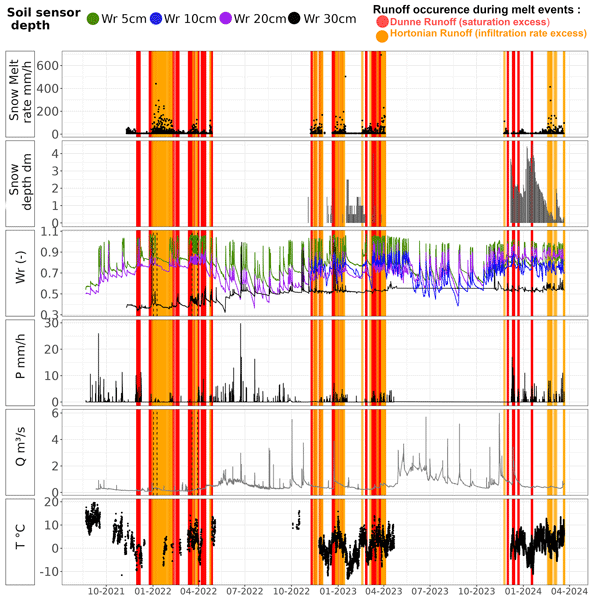
The fate of liquid water from melting snow in winter and spring is difficult to understand in the mountains. This work uses a multi-instrumental network to accurately monitor the dynamics of snowmelt and infiltration at different depths in the ground and at different altitudes. The results show that melting snow quickly infiltrates into the upper layers of the soil but is also quickly transferred through the soil along the slopes towards the river.
Álvaro Pardo-Álvarez, Jan H. Fleckenstein, Kalliopi Koutantou, and Philip Brunner
EGUsphere, https://doi.org/10.5194/egusphere-2025-3521, https://doi.org/10.5194/egusphere-2025-3521, 2025
Short summary
Short summary
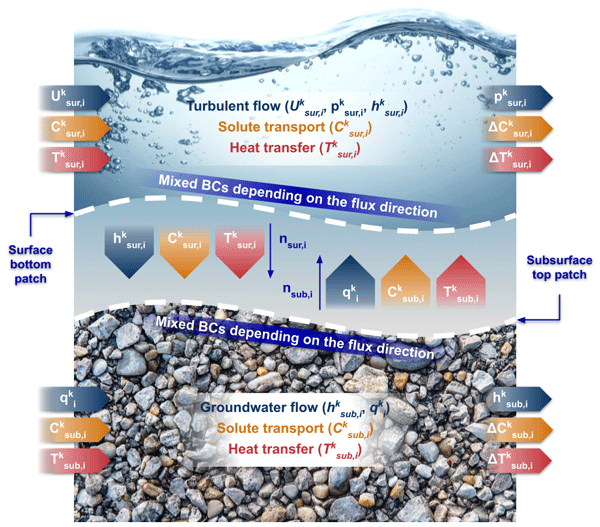
An upgraded version of a numerical solver is introduced to better capture the three-dimensional interactions between surface water and groundwater. Built using open-source software, it adds new features to handle the complexity of real environments, including the representation of subsurface geology and the simulation of diverse dynamic processes, such as solute transport and heat transfer, in both domains. A test case and a full description of the novel features are provided in this paper.
Cyprien Louis, Landon J. S. Halloran, and Clément Roques
Hydrol. Earth Syst. Sci., 29, 1505–1523, https://doi.org/10.5194/hess-29-1505-2025, https://doi.org/10.5194/hess-29-1505-2025, 2025
Short summary
Short summary
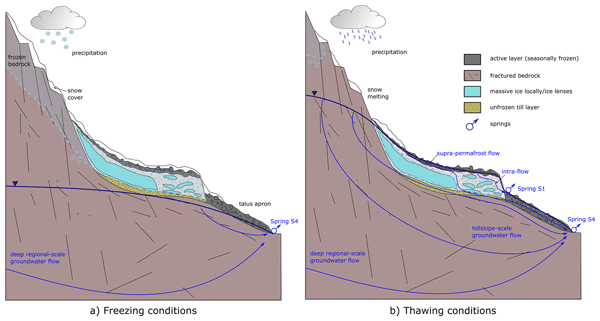
We investigate the freeze–thaw cycles of a rock glacier located in Switzerland and their influence on subsurface hydrology. By analyzing aerial pictures, we estimate the evolution of its creeping velocity on an inter-annual scale. We use geochemical tracers measured at springs to identify the mixing of meltwater and deep groundwater on seasonal to diurnal timescales. This study provides new insights into the cryo-hydrogeological processes that regulate water fluxes in mountain regions.
Alexandre Gauvain, Ronan Abhervé, Alexandre Coche, Martin Le Mesnil, Clément Roques, Camille Bouchez, Jean Marçais, Sarah Leray, Etienne Marti, Ronny Figueroa, Etienne Bresciani, Camille Vautier, Bastien Boivin, June Sallou, Johan Bourcier, Benoit Combemale, Philip Brunner, Laurent Longuevergne, Luc Aquilina, and Jean-Raynald de Dreuzy
EGUsphere, https://doi.org/10.5194/egusphere-2024-3962, https://doi.org/10.5194/egusphere-2024-3962, 2025
Preprint archived
Short summary
Short summary
HydroModPy is an open-source toolbox that makes it easier to study and model groundwater flow at catchment scale. By combining mapping tools with groundwater modeling, it automates the process of building, analyzing and deploying aquifer models. This allows researchers to simulate groundwater flow that sustains stream baseflows, providing insights for the hydrology community. Designed to be accessible and customizable, HydroModPy supports sustainable water management, research, and education.
Qi Tang, Hugo Delottier, Wolfgang Kurtz, Lars Nerger, Oliver S. Schilling, and Philip Brunner
Geosci. Model Dev., 17, 3559–3578, https://doi.org/10.5194/gmd-17-3559-2024, https://doi.org/10.5194/gmd-17-3559-2024, 2024
Short summary
Short summary
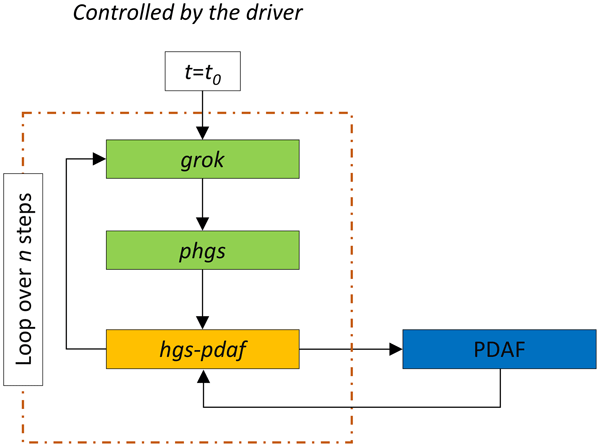
We have developed a new data assimilation framework by coupling an integrated hydrological model HydroGeoSphere with the data assimilation software PDAF. Compared to existing hydrological data assimilation systems, the advantage of our newly developed framework lies in its consideration of the physically based model; its large selection of different assimilation algorithms; and its modularity with respect to the combination of different types of observations, states and parameters.
Ronan Abhervé, Clément Roques, Alexandre Gauvain, Laurent Longuevergne, Stéphane Louaisil, Luc Aquilina, and Jean-Raynald de Dreuzy
Hydrol. Earth Syst. Sci., 27, 3221–3239, https://doi.org/10.5194/hess-27-3221-2023, https://doi.org/10.5194/hess-27-3221-2023, 2023
Short summary
Short summary
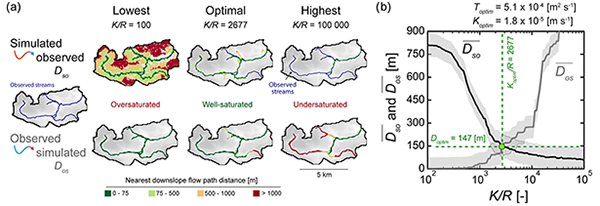
We propose a model calibration method constraining groundwater seepage in the hydrographic network. The method assesses the hydraulic properties of aquifers in regions where perennial streams are directly fed by groundwater. The estimated hydraulic conductivity appear to be highly sensitive to the spatial extent and density of streams. Such an approach improving subsurface characterization from surface information is particularly interesting for ungauged basins.
Hugo Delottier, John Doherty, and Philip Brunner
Geosci. Model Dev., 16, 4213–4231, https://doi.org/10.5194/gmd-16-4213-2023, https://doi.org/10.5194/gmd-16-4213-2023, 2023
Short summary
Short summary
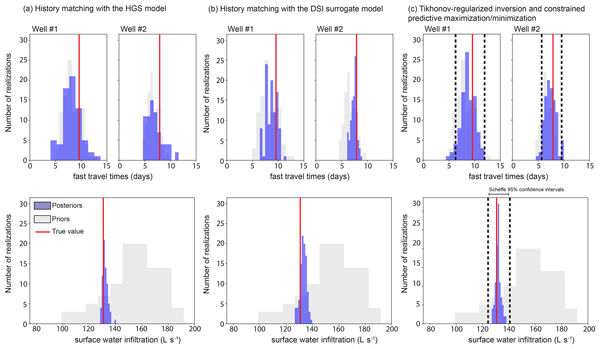
Long run times are usually a barrier to the quantification and reduction of predictive uncertainty with complex hydrological models. Data space inversion (DSI) provides an alternative and highly model-run-efficient method for uncertainty quantification. This paper demonstrates DSI's ability to robustly quantify predictive uncertainty and extend the methodology to provide practical metrics that can guide data acquisition and analysis to achieve goals of decision-support modelling.
Thomas Hermans, Pascal Goderniaux, Damien Jougnot, Jan H. Fleckenstein, Philip Brunner, Frédéric Nguyen, Niklas Linde, Johan Alexander Huisman, Olivier Bour, Jorge Lopez Alvis, Richard Hoffmann, Andrea Palacios, Anne-Karin Cooke, Álvaro Pardo-Álvarez, Lara Blazevic, Behzad Pouladi, Peleg Haruzi, Alejandro Fernandez Visentini, Guilherme E. H. Nogueira, Joel Tirado-Conde, Majken C. Looms, Meruyert Kenshilikova, Philippe Davy, and Tanguy Le Borgne
Hydrol. Earth Syst. Sci., 27, 255–287, https://doi.org/10.5194/hess-27-255-2023, https://doi.org/10.5194/hess-27-255-2023, 2023
Short summary
Short summary
Although invisible, groundwater plays an essential role for society as a source of drinking water or for ecosystems but is also facing important challenges in terms of contamination. Characterizing groundwater reservoirs with their spatial heterogeneity and their temporal evolution is therefore crucial for their sustainable management. In this paper, we review some important challenges and recent innovations in imaging and modeling the 4D nature of the hydrogeological systems.
Clément Roques, David E. Rupp, Jean-Raynald de Dreuzy, Laurent Longuevergne, Elizabeth R. Jachens, Gordon Grant, Luc Aquilina, and John S. Selker
Hydrol. Earth Syst. Sci., 26, 4391–4405, https://doi.org/10.5194/hess-26-4391-2022, https://doi.org/10.5194/hess-26-4391-2022, 2022
Short summary
Short summary
Streamflow dynamics are directly dependent on contributions from groundwater, with hillslope heterogeneity being a major driver in controlling both spatial and temporal variabilities in recession discharge behaviors. By analysing new model results, this paper identifies the major structural features of aquifers driving streamflow dynamics. It provides important guidance to inform catchment-to-regional-scale models, with key geological knowledge influencing groundwater–surface water interactions.
Guilherme E. H. Nogueira, Christian Schmidt, Daniel Partington, Philip Brunner, and Jan H. Fleckenstein
Hydrol. Earth Syst. Sci., 26, 1883–1905, https://doi.org/10.5194/hess-26-1883-2022, https://doi.org/10.5194/hess-26-1883-2022, 2022
Short summary
Short summary
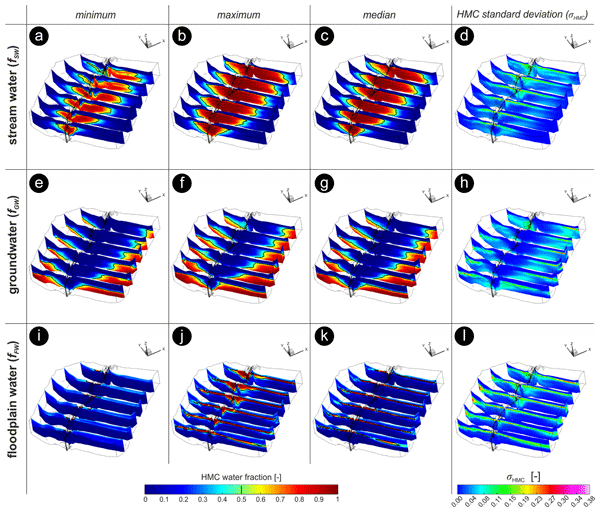
In near-stream aquifers, mixing between stream water and ambient groundwater can lead to dilution and the removal of substances that can be harmful to the water ecosystem at high concentrations. We used a numerical model to track the spatiotemporal evolution of different water sources and their mixing around a stream, which are rather difficult in the field. Results show that mixing mainly develops as narrow spots, varying In time and space, and is affected by magnitudes of discharge events.
K. Koutantou, G. Mazzotti, and P. Brunner
Int. Arch. Photogramm. Remote Sens. Spatial Inf. Sci., XLIII-B3-2021, 477–484, https://doi.org/10.5194/isprs-archives-XLIII-B3-2021-477-2021, https://doi.org/10.5194/isprs-archives-XLIII-B3-2021-477-2021, 2021
Alba Zappone, Antonio Pio Rinaldi, Melchior Grab, Quinn C. Wenning, Clément Roques, Claudio Madonna, Anne C. Obermann, Stefano M. Bernasconi, Matthias S. Brennwald, Rolf Kipfer, Florian Soom, Paul Cook, Yves Guglielmi, Christophe Nussbaum, Domenico Giardini, Marco Mazzotti, and Stefan Wiemer
Solid Earth, 12, 319–343, https://doi.org/10.5194/se-12-319-2021, https://doi.org/10.5194/se-12-319-2021, 2021
Short summary
Short summary
The success of the geological storage of carbon dioxide is linked to the availability at depth of a capable reservoir and an impermeable caprock. The sealing capacity of the caprock is a key parameter for long-term CO2 containment. Faults crosscutting the caprock might represent preferential pathways for CO2 to escape. A decameter-scale experiment on injection in a fault, monitored by an integrated network of multiparamerter sensors, sheds light on the mobility of fluids within the fault.
Cited articles
Courtois, E. A., Stahl, C., Burban, B., Van den Berge, J., Berveiller, D., Bréchet, L., Soong, J. L., Arriga, N., Peñuelas, J., and Janssens, I. A.: Automatic high-frequency measurements of full soil greenhouse gas fluxes in a tropical forest, Biogeosciences, 16, 785–796, https://doi.org/10.5194/bg-16-785-2019, 2019. a
Aubinet, M., Vesala, T., and Papale, D.: Eddy Covariance, Springer Netherlands, Dordrecht, 1. edn., ISBN 978-94-007-2350-4, https://doi.org/10.1007/978-94-007-2351-1, 2012. a
Baldocchi, D.: Measuring fluxes of trace gases and energy between ecosystems and the atmosphere – the state and future of the eddy covariance method, Global Change Biology, 20, 3600–3609, https://doi.org/10.1111/gcb.12649, 2014. a
Baldocchi, D., Falge, E., Gu, L., Olson, R., Hollinger, D., Running, S., Anthoni, P., Bernhofer, C., Davis, K., Evans, R., Fuentes, J., Goldstein, A., Katul, G., Law, J. B., Lee, X., Malhi, Y., Meyers, T., Munger, W., Oechel, W., Paw, K. T., Pilegaard, K., Schmid, H. P., Valentini, R., Verma, S., Vesala, T., Wilson, K., Wofsy, S., and Hall, H.: FLUXNET: A New Tool to Study the Temporal and Spatial Variability of Ecosystem-Scale Carbon Dioxide, Water Vapor, and Energy Flux Densities, Bulletin of the American Meteorological Society, 82, 2415–2434, https://doi.org/10.1175/1520-0477(2001)082<2415:FANTTS>2.3.CO;2, 2001. a
Baldocchi, D. D.: How eddy covariance flux measurements have contributed to our understanding of Global Change Biology, Global Change Biology, 26, 242–260, https://doi.org/10.1111/gcb.14807, 2020. a
Baneschi, I., Raco, B., Magnani, M., Giamberini, M., Lelli, M., Mosca, P., Provenzale, A., Coppo, L., and Guidi, M.: Non-steady-state closed dynamic chamber to measure soil CO2 respiration: A protocol to reduce uncertainty, Frontiers in Environmental Science, 10, https://doi.org/10.3389/fenvs.2022.1048948, 2023. a, b
Basri, M. H. A., McCalmont, J., Kho, L. K., Hartley, I. P., Teh, Y. A., Rumpang, E., Signori-Müller, C., and Hill, T.: Reducing bias on soil surface CO2 flux emission measurements: Case study on a mature oil palm (Elaeis guineensis) plantation on tropical peatland in Southeast Asia, Agricultural and Forest Meteorology, 350, https://doi.org/10.1016/j.agrformet.2024.110002, 2024. a
Christiansen, J. R., Outhwaite, J., and Smukler, S. M.: Comparison of CO2, CH4 and N2O soil-atmosphere exchange measured in static chambers with cavity ring-down spectroscopy and gas chromatography, Agricultural and Forest Meteorology, 211–212, 48–57, https://doi.org/10.1016/j.agrformet.2015.06.004, 2015. a
Chu, H., Luo, X., Ouyang, Z., Chan, W. S., Dengel, S., Biraud, S. C., Torn, M. S., Metzger, S., Kumar, J., Arain, M. A., Arkebauer, T. J., Baldocchi, D., Bernacchi, C., Billesbach, D., Black, T. A., Blanken, P. D., Bohrer, G., Bracho, R., Brown, S., Brunsell, N. A., Chen, J., Chen, X., Clark, K., Desai, A. R., Duman, T., Durden, D., Fares, S., Forbrich, I., Gamon, J. A., Gough, C. M., Griffis, T., Helbig, M., Hollinger, D., Humphreys, E., Ikawa, H., Iwata, H., Ju, Y., Knowles, J. F., Knox, S. H., Kobayashi, H., Kolb, T., Law, B., Lee, X., Litvak, M., Liu, H., Munger, J. W., Noormets, A., Novick, K., Oberbauer, S. F., Oechel, W., Oikawa, P., Papuga, S. A., Pendall, E., Prajapati, P., Prueger, J., Quinton, W. L., Richardson, A. D., Russell, E. S., Scott, R. L., Starr, G., Staebler, R., Stoy, P. C., Stuart-Haëntjens, E., Sonnentag, O., Sullivan, R. C., Suyker, A., Ueyama, M., Vargas, R., Wood, J. D., and Zona, D.: Representativeness of Eddy-Covariance flux footprints for areas surrounding AmeriFlux sites, Agricultural and Forest Meteorology, 301–302, https://doi.org/10.1016/j.agrformet.2021.108350, 2021. a
Cowan, N., Levy, P., Tigli, M., Toteva, G., and Drewer, J.: Characterisation of Analytical Uncertainty in Chamber Soil Flux Measurements, European Journal of Soil Science, 76, e70104, https://doi.org/10.1111/ejss.70104, 2025. a
Egli, M., Wiesenberg, G., Leifeld, J., Gärtner, H., Seibert, J., Röösli, C., Wingate, V., Dollenmeier, W., Griffel, P., Suremann, J., Weber, J., Zyberaj, M., and Musso, A.: Formation and decay of peat bogs in the vegetable belt of Switzerland, Swiss Journal of Geosciences, 114, https://doi.org/10.1186/s00015-020-00376-0, 2021. a
Emmenegger, L., Leuenberger, M., and Steinbacher, M.: ICOS ATC NRT CO2 growing time series, Jungfraujoch (13.9 m), 2024-04-01–2025-01-20, ICOS RI, https://hdl.handle.net/11676/7vqXXFRCjhXpLOOMriAcxkzL, 2025. a
Eugster, W. and Merbold, L.: Eddy covariance for quantifying trace gas fluxes from soils, SOIL, 1, 187–205, https://doi.org/10.5194/soil-1-187-2015, 2015. a, b
Ferré, M., Muller, A., Leifeld, J., Bader, C., Müller, M., Engel, S., and Wichmann, S.: Sustainable management of cultivated peatlands in Switzerland: Insights, challenges, and opportunities, Land Use Policy, 87, https://doi.org/10.1016/j.landusepol.2019.05.038, 2019. a
Forbes, E., Benenati, V., Frey, S., Hirsch, M., Koech, G., Lewin, G., Mantas, J. N., and Caylor, K.: Fluxbots: A Method for Building, Deploying, Collecting and Analyzing Data From an Array of Inexpensive, Autonomous Soil Carbon Flux Chambers, Journal of Geophysical Research: Biogeosciences, 128, https://doi.org/10.1029/2023JG007451, 2023. a, b, c
Görres, C.-M., Kammann, C., and Ceulemans, R.: Automation of soil flux chamber measurements: potentials and pitfalls, Biogeosciences, 13, 1949–1966, https://doi.org/10.5194/bg-13-1949-2016, 2016. a
Healy, R. W., Striegl, R. G., Russell, T. F., Hutchinson, G. L., and Livingston, G. P.: Numerical Evaluation of Static-Chamber Measurements of Soil-Atmosphere Gas Exchange: Identification of Physical Processes, Tech. rep., Soil Science Society of America Journal, 60, https://doi.org/10.2136/sssaj1996.03615995006000030009x, 1996. a
Hüppi, R., Felber, R., Krauss, M., Six, J., Leifeld, J., and Fuß, R.: Restricting the nonlinearity parameter in soil greenhouse gas flux calculation for more reliable flux estimates, PLoS ONE, 13, https://doi.org/10.1371/journal.pone.0200876, 2018. a
IPCC: Intergovernmental panel on climate change (IPCC) guidelines for national greenhouse gas inventories, Volume 4. Agriculture, forestry and other land uses, Tech. rep., https://www.ipcc-nggip.iges.or.jp/public/2006gl (last access: 10 November 2025), 2006. a
IPCC: 2019 Refinement to the 2006 IPCC Guidelines for National Greenhouse Gas Inventories, Volume 4. Agriculture, forestry and other land uses, Tech. rep., https://www.ipcc.ch/report/2019-refinement-to-the-2006-ipcc-guidelines-for-national-greenhouse-gas-inventories/ (last access: 10 November 2025), 2019. a
IPCC: Summary for policymakers, in: Climate change 2021: The physical science basis, Contribution of Working Group I to the Sixth Assessment Report of the Intergovernmental Panel on Climate Change, Tech. rep., https://doi.org/10.1017/9781009157896.001, 2021. a
Jenerette, G. D., Scott, R. L., and Huxman, T. E.: Whole ecosystem metabolic pulses following precipitation events, Functional Ecology, 22, 924–930, https://doi.org/10.1111/j.1365-2435.2008.01450.x, 2008. a
Johannesson, C.-F., Nordén, J., Lange, H., Silvennoinen, H., and Larsen, K.: Optimizing the closure period for improved accuracy of chamber-based greenhouse gas flux estimates, Agricultural and Forest Meteorology, 359, 110289, https://doi.org/10.1016/j.agrformet.2024.110289, 2024. a
Kobayashi, A. N. A.: alexnaoki/SoilGasFlux: v.0.2.0 Parametric low-cost soil gas flux system, Zenodo [code], https://doi.org/10.5281/zenodo.17341515, 2025. a, b, c
Lai, D. Y. F., Roulet, N. T., Humphreys, E. R., Moore, T. R., and Dalva, M.: The effect of atmospheric turbulence and chamber deployment period on autochamber CO2 and CH4 flux measurements in an ombrotrophic peatland, Biogeosciences, 9, 3305–3322, https://doi.org/10.5194/bg-9-3305-2012, 2012. a
Leon, E., Vargas, R., Bullock, S., Lopez, E., Panosso, A. R., and La Scala, N.: Hot spots, hot moments, and spatio-temporal controls on soil CO2 efflux in a water-limited ecosystem, Soil Biology and Biochemistry, 77, 12–21, https://doi.org/10.1016/j.soilbio.2014.05.029, 2014. a
Macagga, R., Asante, M., Sossa, G., Antonijević, D., Dubbert, M., and Hoffmann, M.: Validation and field application of a low-cost device to measure CO2 and evapotranspiration (ET) fluxes, Atmos. Meas. Tech., 17, 1317–1332, https://doi.org/10.5194/amt-17-1317-2024, 2024. a, b, c, d
Maier, M., Weber, T. K., Fiedler, J., Fuß, R., Glatzel, S., Huth, V., Jordan, S., Jurasinski, G., Kutzbach, L., Schäfer, K., Weymann, D., and Hagemann, U.: Introduction of a guideline for measurements of greenhouse gas fluxes from soils using non-steady-state chambers, Journal of Plant Nutrition and Soil Science, 185, 447–461, https://doi.org/10.1002/jpln.202200199, 2022. a, b, c, d
Nickerson, N.: Evaluating Gas Emission Measurements Using Minimum Detectable Flux (MDF), Tech. rep., https://doi.org/10.13140/RG.2.1.4149.2089, 2016. a
Oertel, C., Matschullat, J., Zurba, K., Zimmermann, F., and Erasmi, S.: Greenhouse gas emissions from soils – A review, Geochemistry, 76, https://doi.org/10.1016/j.chemer.2016.04.002, 2016. a
Pedersen, A. R., Petersen, S. O., and Schelde, K.: A comprehensive approach to soil-atmosphere trace-gas flux estimation with static chambers, European Journal of Soil Science, 61, 888–902, https://doi.org/10.1111/j.1365-2389.2010.01291.x, 2010. a
Roeoesli, C. and Egli, M.: Using historical data to access the surface subsidence in the vegetable belt of the Three Lakes Region, Switzerland, Swiss Journal of Geosciences, 117, https://doi.org/10.1186/s00015-024-00452-9, 2024. a
Schneider, J., Kutzbach, L., Schulz, S., and Wilmldng, M.: Overestimation of CO2 respiration fluxes by the closed chamber method in low-turbulence nighttime conditions, Journal of Geophysical Research: Biogeosciences, 114, https://doi.org/10.1029/2008JG000909, 2009. a
Smith, K. A., Ball, T., Conen, F., Dobbie, K. E., Massheder, J., and Rey, A.: Exchange of greenhouse gases between soil and atmosphere: interactions of soil physical factors and biological processes, European Journal of Soil Science, 69, 10–20, https://doi.org/10.1111/ejss.12539, 2018. a
Venterea, R. T. and Baker, J. M.: Effects of Soil Physical Nonuniformity on Chamber‐Based Gas Flux Estimates, Soil Science Society of America Journal, 72, 1410–1417, https://doi.org/10.2136/sssaj2008.0019, 2008. a
Venterea, R. T., Petersen, S. O., De Klein, C. A. M., Pedersen, A. R., Noble, A. D. L., Rees, R. M., Gamble, J. D., and Parkin, T. B.: Global Research Alliance N2O Chamber Methodology Guidelines: Flux Calculations, Journal of Environmental Quality, 49, 1141–1155, https://doi.org/10.1002/jeq2.20118, 2020. a
Zawilski, B. M. and Bustillo, V.: Ultra-low-cost manual soil respiration chamber, Geosci. Instrum. Method. Data Syst., 13, 51–62, https://doi.org/10.5194/gi-13-51-2024, 2024. a, b
Short summary
The increasing impact of climate change and human activities on greenhouse gas emissions highlights the need for effective monitoring, especially from the soil. Our design introduces a low-cost solution for measuring soil gas flux that is adaptable to various environments. Additionally, we propose a novel method for ensuring data quality before deploying these systems in the field.
The increasing impact of climate change and human activities on greenhouse gas emissions...