
Articles | Volume 14, issue 2
https://doi.org/10.5194/gi-14-407-2025
© Author(s) 2025. This work is distributed under
the Creative Commons Attribution 4.0 License.
the Creative Commons Attribution 4.0 License.
https://doi.org/10.5194/gi-14-407-2025
© Author(s) 2025. This work is distributed under
the Creative Commons Attribution 4.0 License.
the Creative Commons Attribution 4.0 License.
Research article
| 
02 Dec 2025
Research article |
| 02 Dec 2025
| 02 Dec 2025
Measurements on physical snow properties in Dronning Maud Land, Antarctica

Finnish Meteorological Institute, 99600 Sodankylä, Finland
Arctic Centre, University of Lapland, 96100 Rovaniemi, Finland
Antero Kukko
Finnish Geospatial Research Institute, 02150 Espoo, Finland
Aleksi Rimali
Finnish Meteorological Institute, 99600 Sodankylä, Finland
Aku Riihelä
Finnish Meteorological Institute, 00101 Helsinki, Finland
Priit Tisler
Finnish Meteorological Institute, 00101 Helsinki, Finland
Related authors
Marina Falke, Leena Leppänen, Jaakko Nissilä, and Christian Beer
EGUsphere, https://doi.org/10.5194/egusphere-2025-5771, https://doi.org/10.5194/egusphere-2025-5771, 2025
Short summary
Short summary
The study examined spatial and temporal variability of taiga snowpack during spring melt using weekly measurements of height, stratigraphy, temperature, and density at four Sodankylä sites. Snow height peaked on 30 Mar. Density increased through melt, reaching ~ 500 kg/m³ by late Apr–early May. Snow structure shifted from depth hoar to melt forms, and temperatures reached 0 °C throughout. By 10 May, snow cover disappeared. Findings highlight evolving, heterogeneous melt-season snow properties.
Aimad El Issaoui, Veikka Taka, Harri Kaartinen, Antero Kukko, and Juha Hyyppä
Int. Arch. Photogramm. Remote Sens. Spatial Inf. Sci., XLIX-B2-2026, 169–174, https://doi.org/10.5194/isprs-archives-XLIX-B2-2026-169-2026, https://doi.org/10.5194/isprs-archives-XLIX-B2-2026-169-2026, 2026
Susanna Hyyppä, Josef Taher, Matti Hyyppä, Leena Matikainen, Xiaowei Yu, Harri Kaartinen, Oskari Saarinen, Kirsi Karila, Ville Luoma, Marjut Turtiainen, Birgitta Partanen, Roope Näsi, Jyri Maanpää, Eetu Puttonen, Arttu Kivimäki, Mikko Vastaranta, Antero Kukko, Hannu Hyyppä, Matti Vaaja, Fabio Remondino, Narges Takhtkeshha, and Juha Hyyppä
Int. Arch. Photogramm. Remote Sens. Spatial Inf. Sci., XLIX-B1-2026, 443–448, https://doi.org/10.5194/isprs-archives-XLIX-B1-2026-443-2026, https://doi.org/10.5194/isprs-archives-XLIX-B1-2026-443-2026, 2026
Zuoya Liu, Harri Kaartinen, Antero Kukko, Juha Hyyppa, and Ruizhi Chen
ISPRS Ann. Photogramm. Remote Sens. Spatial Inf. Sci., XI-1-2026, 297–302, https://doi.org/10.5194/isprs-annals-XI-1-2026-297-2026, https://doi.org/10.5194/isprs-annals-XI-1-2026-297-2026, 2026
Simona F. Ruso, Gordon R. Osinski, Anna Grau Galofre, and Antero Kukko
EGUsphere, https://doi.org/10.5194/egusphere-2025-5667, https://doi.org/10.5194/egusphere-2025-5667, 2026
Short summary
Short summary
We describe the morphological characteristics of anastomosing (labyrinthine) bedrock channels to enhance the current understanding of subglacial meltwater dynamics of the Innuitian Ice Sheet. Our work reveals a morphological similarity between labyrinthine channels and other landscapes modified by glacial floods. We argue that the presence of anastomosis, distinct erosional surfaces, and longitudinal profile slope breaks imply formation by short-lived episodes of erosion associated with floods.
Marina Falke, Leena Leppänen, Jaakko Nissilä, and Christian Beer
EGUsphere, https://doi.org/10.5194/egusphere-2025-5771, https://doi.org/10.5194/egusphere-2025-5771, 2025
Short summary
Short summary
The study examined spatial and temporal variability of taiga snowpack during spring melt using weekly measurements of height, stratigraphy, temperature, and density at four Sodankylä sites. Snow height peaked on 30 Mar. Density increased through melt, reaching ~ 500 kg/m³ by late Apr–early May. Snow structure shifted from depth hoar to melt forms, and temperatures reached 0 °C throughout. By 10 May, snow cover disappeared. Findings highlight evolving, heterogeneous melt-season snow properties.
Joonas Kousa, Teemu Hakala, Antero Kukko, and Harri Kaartinen
ISPRS Ann. Photogramm. Remote Sens. Spatial Inf. Sci., X-2-W2-2025, 101–108, https://doi.org/10.5194/isprs-annals-X-2-W2-2025-101-2025, https://doi.org/10.5194/isprs-annals-X-2-W2-2025-101-2025, 2025
Adriano Lemos and Aku Riihelä
The Cryosphere, 19, 3939–3947, https://doi.org/10.5194/tc-19-3939-2025, https://doi.org/10.5194/tc-19-3939-2025, 2025
Short summary
Short summary
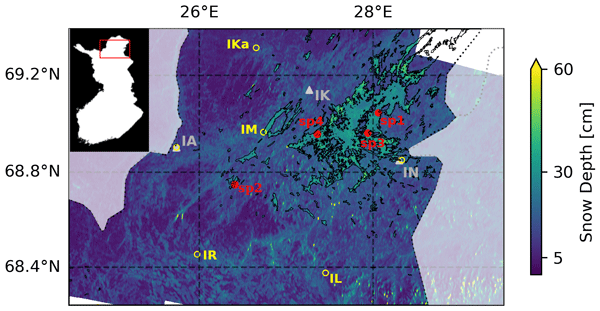
Here we used satellite imagery to measure snow depth in northern Finland and compared our results to on-site measurements from 2019–2022. We correlated snow depths and vegetation coverage and found thicker snow over non-vegetated areas and frozen waterbodies due to the satellite's sensitivity. Our estimates showed underestimated results of snow depth and need further investigation, but they show potential in monitoring seasonal snow changes, particularly where direct measurements are lacking.
Zuoya Liu, Harri Kaartinen, Teemu Hakala, Heikki Hyyti, Antero Kukko, Juha Hyyppa, and Ruizhi Chen
ISPRS Ann. Photogramm. Remote Sens. Spatial Inf. Sci., X-G-2025, 551–557, https://doi.org/10.5194/isprs-annals-X-G-2025-551-2025, https://doi.org/10.5194/isprs-annals-X-G-2025-551-2025, 2025
Tamás Faitli, Heikki Hyyti, Juha Hyyppä, Antero Kukko, and Harri Kaartinen
Int. Arch. Photogramm. Remote Sens. Spatial Inf. Sci., XLVIII-1-W4-2025, 37–42, https://doi.org/10.5194/isprs-archives-XLVIII-1-W4-2025-37-2025, https://doi.org/10.5194/isprs-archives-XLVIII-1-W4-2025-37-2025, 2025
Shannon M. Hibbard, Gordon R. Osinski, Etienne Godin, Chimira Andres, Antero Kukko, Shawn Chartrand, Anna Grau Galofre, A. Mark Jellinek, and Wendy Boucher
The Cryosphere, 19, 1695–1716, https://doi.org/10.5194/tc-19-1695-2025, https://doi.org/10.5194/tc-19-1695-2025, 2025
Short summary
Short summary
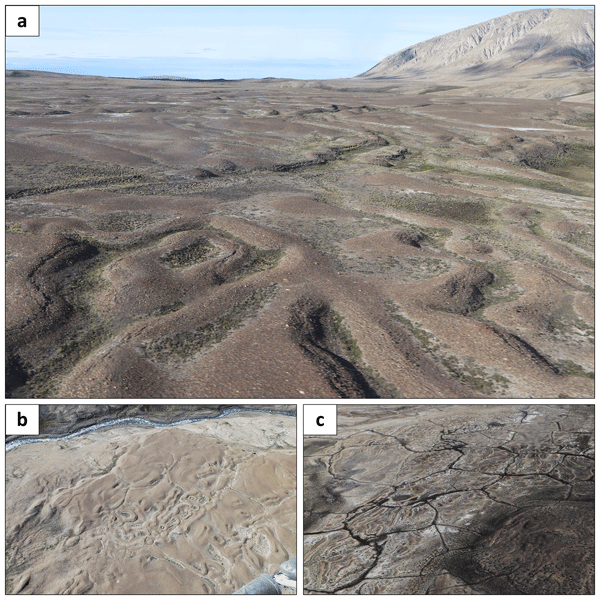
This study investigates enigmatic ring forms found on Axel Heiberg Island (Umingmat Nunaat) in Nunavut, Canada. These ring forms comprised a series of ridges and troughs creating individual rings or brain-like patterns. We aim to identify how they form and assess the past climate conditions necessary for their formation. We use surface and subsurface observations and comparisons to other periglacial and glacial ring forms to infer a formation mechanism and propose a glacial origin.
Letícia F. Castanheiro, Antonio M. G. Tommaselli, Heikki Hyyti, and Antero Kukko
Int. Arch. Photogramm. Remote Sens. Spatial Inf. Sci., XLVIII-3-2024, 57–62, https://doi.org/10.5194/isprs-archives-XLVIII-3-2024-57-2024, https://doi.org/10.5194/isprs-archives-XLVIII-3-2024-57-2024, 2024
Emmihenna Jääskeläinen, Kerttu Kouki, and Aku Riihelä
Hydrol. Earth Syst. Sci., 28, 3855–3870, https://doi.org/10.5194/hess-28-3855-2024, https://doi.org/10.5194/hess-28-3855-2024, 2024
Short summary
Short summary
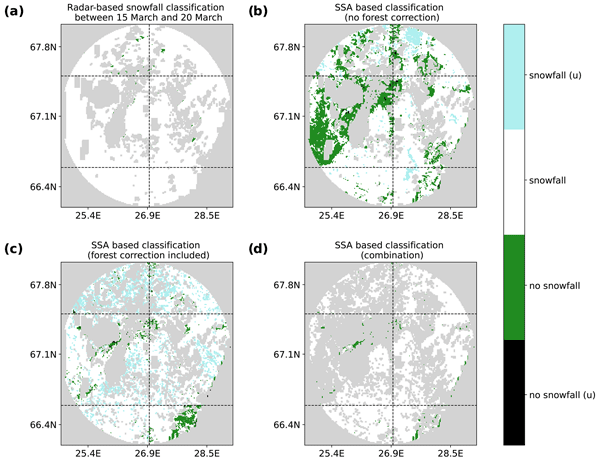
Snow cover is an important variable when studying the effect of climate change in the Arctic. Therefore, the correct detection of snowfall is important. In this study, we present methods to detect snowfall accurately using satellite observations. The snowfall event detection results of our limited area are encouraging. We find that further development could enable application over the whole Arctic, providing necessary information on precipitation occurrence over remote areas.
Mariana Batista Campos, Leticia Ferrari Castanheiro, Dipal Shah, Yunsheng Wang, Antero Kukko, and Eetu Puttonen
Int. Arch. Photogramm. Remote Sens. Spatial Inf. Sci., XLVIII-1-2024, 43–50, https://doi.org/10.5194/isprs-archives-XLVIII-1-2024-43-2024, https://doi.org/10.5194/isprs-archives-XLVIII-1-2024-43-2024, 2024
Aku Riihelä, Emmihenna Jääskeläinen, and Viivi Kallio-Myers
Earth Syst. Sci. Data, 16, 1007–1028, https://doi.org/10.5194/essd-16-1007-2024, https://doi.org/10.5194/essd-16-1007-2024, 2024
Short summary
Short summary
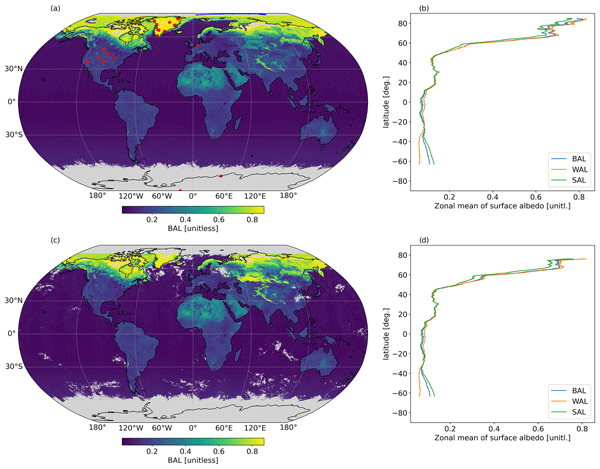
We describe a new climate data record describing the surface albedo, or reflectivitity, of Earth's surface (called CLARA-A3 SAL). The climate data record spans over 4 decades of satellite observations, beginning in 1979. We conduct a quality assessment of the generated data, comparing them against other satellite data and albedo observations made on the ground. We find that the new data record in general matches surface observations well and is stable through time.
Kerttu Kouki, Kari Luojus, and Aku Riihelä
The Cryosphere, 17, 5007–5026, https://doi.org/10.5194/tc-17-5007-2023, https://doi.org/10.5194/tc-17-5007-2023, 2023
Short summary
Short summary
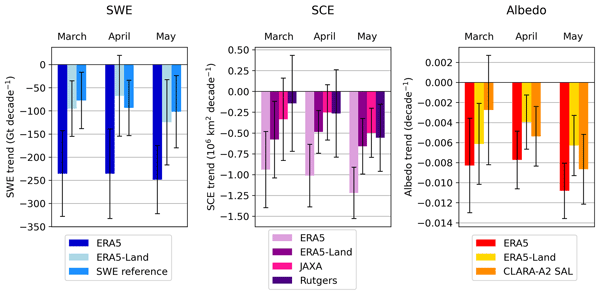
We evaluated snow cover properties in state-of-the-art reanalyses (ERA5 and ERA5-Land) with satellite-based datasets. Both ERA5 and ERA5-Land overestimate snow mass, whereas albedo estimates are more consistent between the datasets. Snow cover extent (SCE) is accurately described in ERA5-Land, while ERA5 shows larger SCE than the satellite-based datasets. The trends in snow mass, SCE, and albedo are mostly negative in 1982–2018, and the negative trends become more apparent when spring advances.
Karl-Göran Karlsson, Martin Stengel, Jan Fokke Meirink, Aku Riihelä, Jörg Trentmann, Tom Akkermans, Diana Stein, Abhay Devasthale, Salomon Eliasson, Erik Johansson, Nina Håkansson, Irina Solodovnik, Nikos Benas, Nicolas Clerbaux, Nathalie Selbach, Marc Schröder, and Rainer Hollmann
Earth Syst. Sci. Data, 15, 4901–4926, https://doi.org/10.5194/essd-15-4901-2023, https://doi.org/10.5194/essd-15-4901-2023, 2023
Short summary
Short summary
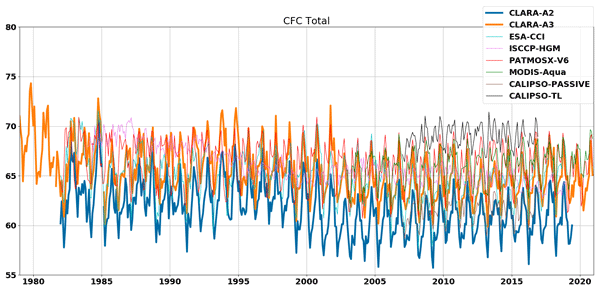
This paper presents a global climate data record on cloud parameters, radiation at the surface and at the top of atmosphere, and surface albedo. The temporal coverage is 1979–2020 (42 years) and the data record is also continuously updated until present time. Thus, more than four decades of climate parameters are provided. Based on CLARA-A3, studies on distribution of clouds and radiation parameters can be made and, especially, investigations of climate trends and evaluation of climate models.
T. Faitli, T. Hakala, H. Kaartinen, J. Hyyppä, and A. Kukko
Int. Arch. Photogramm. Remote Sens. Spatial Inf. Sci., XLVIII-1-W1-2023, 145–150, https://doi.org/10.5194/isprs-archives-XLVIII-1-W1-2023-145-2023, https://doi.org/10.5194/isprs-archives-XLVIII-1-W1-2023-145-2023, 2023
L. F. Castanheiro, A. M. G. Tommaselli, T. A. C. Garcia, M. B. Campos, and A. Kukko
Int. Arch. Photogramm. Remote Sens. Spatial Inf. Sci., XLVIII-1-W1-2023, 71–77, https://doi.org/10.5194/isprs-archives-XLVIII-1-W1-2023-71-2023, https://doi.org/10.5194/isprs-archives-XLVIII-1-W1-2023-71-2023, 2023
Kerttu Kouki, Petri Räisänen, Kari Luojus, Anna Luomaranta, and Aku Riihelä
The Cryosphere, 16, 1007–1030, https://doi.org/10.5194/tc-16-1007-2022, https://doi.org/10.5194/tc-16-1007-2022, 2022
Short summary
Short summary
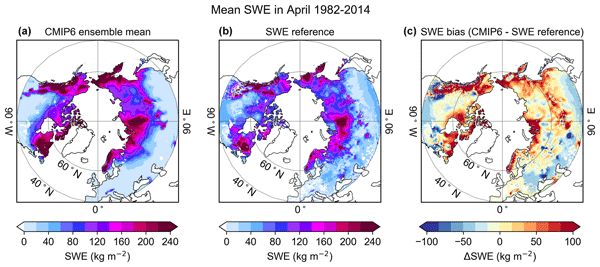
We analyze state-of-the-art climate models’ ability to describe snow mass and whether biases in modeled temperature or precipitation can explain the discrepancies in snow mass. In winter, biases in precipitation are the main factor affecting snow mass, while in spring, biases in temperature becomes more important, which is an expected result. However, temperature or precipitation cannot explain all snow mass discrepancies. Other factors, such as models’ structural errors, are also significant.
Terhikki Manninen, Emmihenna Jääskeläinen, Niilo Siljamo, Aku Riihelä, and Karl-Göran Karlsson
Atmos. Meas. Tech., 15, 879–893, https://doi.org/10.5194/amt-15-879-2022, https://doi.org/10.5194/amt-15-879-2022, 2022
Short summary
Short summary
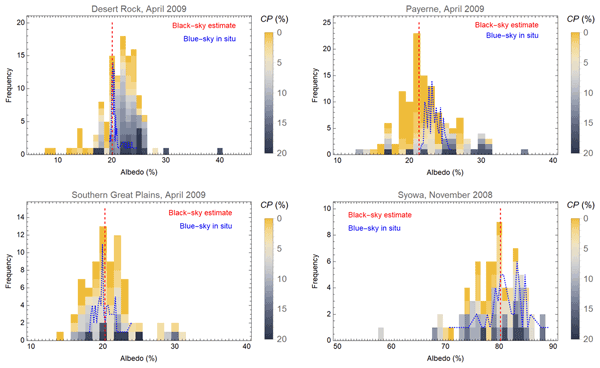
A new method for cloud-correcting observations of surface albedo is presented for AVHRR data. Instead of a binary cloud mask, it applies cloud probability values smaller than 20% of the A3 edition of the CLARA (CM SAF cLoud, Albedo and surface Radiation dataset from AVHRR data) record provided by the Satellite Application Facility on Climate Monitoring (CM SAF) project of EUMETSAT. According to simulations, the 90% quantile was 1.1% for the absolute albedo error and 2.2% for the relative error.
Cited articles
Fierz, C., Armstrong, R. L., Durand, Y., Etchevers, P., Greene, E., McClung, D. M., Nishimura, K., Satyawali, P. K., and Sokratov, S. A.: The International Classification for Seasonal Snow on the Ground, IHP-VII Technical Documents in Hydrology No 83, IACS Contribution No 1, UNESCO-IHP, Paris, 2009.
FINNARP: Field operations 2018–2019, https://assets.ctfassets.net/hli0qi7fbbos/3X4EyCfSIaz0v46TQUDG1o/e57a3c4418f558fd295a1619c1ebc705/FINNARP_2018_web.pdf (last access: 30 April 2025), 2019.
Gallet, J.-C., Domine, F., Zender, C. S., and Picard, G.: Measurement of the specific surface area of snow using infrared reflectance in an integrating sphere at 1310 and 1550 nm, The Cryosphere, 3, 167–182, https://doi.org/10.5194/tc-3-167-2009, 2009.
Goodwin, I. D.: Snow-accumulation variability from seasonal surface observations and firn-core stratigraphy, eastern Wilkes Land, Antarctica, J. Glaciol., 37, 383–387, https://doi.org/10.3189/S0022143000005815, 1991.
Ingvander, S., Jansson, P., Brown, I. A., Fujita, S., Sugyama, S., Surdyk, S., Enomoto, H., Hansson, M., and Holmlund, P.: Snow particle sizes and their distributions in Dronning Maud Land, Antarctica, at sample, local and regional scales, Antarctic Science, 28, 219–231, https://doi.org/10.1017/S0954102015000589, 2016.
Isaksson, E. and Karlén, W.: Spatial and temporal patterns in snow accumulation, western Dronning Maud Land, Antarctica, J. Glaciol., 40, 399–409, https://doi.org/10.3189/S0022143000007486, 1994.
Järvinen, O. and Leppäranta, M.: Solar radiation transfer in the surface snow layer in Dronning Maud Land, Antarctica, Polar Science, 7, 1–17, https://doi.org/10.1016/j.polar.2013.03.002, 2013.
Kärkäs, E., Granberg, H. B., Kanto, K., Rasmus, K., Lavoie, C., and Leppäranta, M.: Physical properties of the seasonal snow cover in Dronning Maud Land, East Antarctica, Ann. Glaciol, 34, 89–94, https://doi.org/10.3189/172756402781817554, 2002.
Kärkäs, E., Martma, T., and Sonninen, E.: Physical properties and stratigraphy of surface snow in western Dronning Maud Land, Antarctica, Polar Research, 24, 55–67, https://doi.org/10.3402/polar.v24i1.6253, 2005.
Leppänen, L., Kontu, A., Hannula, H.-R., Sjöblom, H., and Pulliainen, J.: Sodankylä manual snow survey program, Geosci. Instrum. Method. Data Syst., 5, 163–179, https://doi.org/10.5194/gi-5-163-2016, 2016.
Leppänen, L., Kukko, A., Rimali, A., Riihelä, A., and Tisler., P.: LAS3R field campaign, Aboa, Antarctica, 2022-23: Snow pit, AWS5, albedo, RGB drone mosaics, surface roughness and elevation, B2SHARE [data set], https://doi.org/10.57707/fmi-b2share.900cf0c74c1c45efb396b910a841bb3c, 2025.
Mosley-Thompson, E., Kruss, P. D., Thompson, L. G., Pourchet, M., and Grootes, P.: Snow stratigraphic record at South Pole: potential for paleoclimatic reconstruction, Ann. Glaciol., 7, 26–33, https://doi.org/10.3189/S0260305500005863, 1985.
Picard, G. and Libois, Q.: Simulation of snow albedo and solar irradiance profile with the Two-streAm Radiative TransfEr in Snow (TARTES) v2.0 model, Geosci. Model Dev., 17, 8927–8953, https://doi.org/10.5194/gmd-17-8927-2024, 2024.
Picard, G., Libois, Q., Arnaud, L., Verin, G., and Dumont, M.: Development and calibration of an automatic spectral albedometer to estimate near-surface snow SSA time series, The Cryosphere, 10, 1297–1316, https://doi.org/10.5194/tc-10-1297-2016, 2016.
Pirazzini, R., Räisänen, P., Vihma, T., Johansson, M., and Tastula, E.-M.: Measurements and modelling of snow particle size and shortwave infrared albedo over a melting Antarctic ice sheet, The Cryosphere, 9, 2357–2381, https://doi.org/10.5194/tc-9-2357-2015, 2015.
Rasmus, K.: Field measurements of the total and spectral albedo of snow and ice in Dronning Maud Land, Antarctica, Geophysica, 42, 17–34, 2006.
Reijmer, C. H. and Van Den Broeke, M. R.: Temporal and spatial variability of the surface mass balance in Dronning Maud Land, Antarctica, as derived from automatic weather stations, J. Glaciol., 49, 512–520, https://doi.org/10.3189/172756503781830494, 2003.
Sihvola, A. and Tiuri, M.: Snow fork for field determination of the density and wetness profiles of a snow pack, IEEE T. Geosci. Remote, GE-24, 717–721, https://doi.org/10.1109/TGRS.1986.289619, 1986.
Sinisalo, A., Grinsted, A., Moore, J. C., Kärkäs, E., and Pettersson, R.: Snow-accumulation studies in Antarctica with ground-penetrating radar using 50, 100 and 800 MHz antenna frequencies, Ann. Glaciol, 37, 194–198, https://doi.org/10.3189/172756403781815825, 2003.
Vihma, T., Mattila, O.-P., Pirazzini, R., and Johansson, M. M.: Spatial and temporal variability in summer snow pack in Dronning Maud Land, Antarctica, The Cryosphere, 5, 187–201, https://doi.org/10.5194/tc-5-187-2011, 2011.
Zuanon, N.: IceCube, a portable and reliable instruments for snow specific surface area measurement in the field, in: International Snow Science Workshop Grenoble-Chamonix Mont Blance-2013 proceedings, 1020–1023, 2013.
Short summary
We present field measurements collected during the Finnish Antarctic Research Program (FINNARP) 2022 expedition at Aboa station in Dronning Maud Land, Antarctica. Weekly observations were taken at the automatic weather station site and at selected overpass locations of two satellites. The dataset includes continuous meteorological records, snow pit profiles, ground- and drone-based radiation measurements, and snow surface roughness from laser scans.
We present field measurements collected during the Finnish Antarctic Research Program (FINNARP)...


