
Articles | Volume 14, issue 2
https://doi.org/10.5194/gi-14-447-2025
© Author(s) 2025. This work is distributed under
the Creative Commons Attribution 4.0 License.
the Creative Commons Attribution 4.0 License.
https://doi.org/10.5194/gi-14-447-2025
© Author(s) 2025. This work is distributed under
the Creative Commons Attribution 4.0 License.
the Creative Commons Attribution 4.0 License.
Research article
| 
08 Dec 2025
Research article |
| 08 Dec 2025
| 08 Dec 2025
Comparison of noise levels of two magnetometer types and their suitability for different space environments
Gerlinde Timmermann
CORRESPONDING AUTHOR

Institute of Geophysics and Extraterrestrial Physics, TU Braunschweig, Braunschweig, Germany
David Fischer
Space Research Institute, Austrian Academy of Sciences, Graz, Austria
Hans-Ulrich Auster
Institute of Geophysics and Extraterrestrial Physics, TU Braunschweig, Braunschweig, Germany
Ingo Richter
Institute of Geophysics and Extraterrestrial Physics, TU Braunschweig, Braunschweig, Germany
Benjamin Grison
Institute of Atmospheric Physics of the Czech Academy of Sciences, Department of Space Physics, Prague, Czech Republic
Ferdinand Plaschke
Institute of Geophysics and Extraterrestrial Physics, TU Braunschweig, Braunschweig, Germany
Related authors
No articles found.
Adrian Pöppelwerth, Hans-Ulrich Auster, Vassilis Angelopoulos, James M. McTiernan, James W. Lewis, and Ferdinand Plaschke
Geosci. Instrum. Method. Data Syst., 15, 273–289, https://doi.org/10.5194/gi-15-273-2026, https://doi.org/10.5194/gi-15-273-2026, 2026
Short summary
Short summary
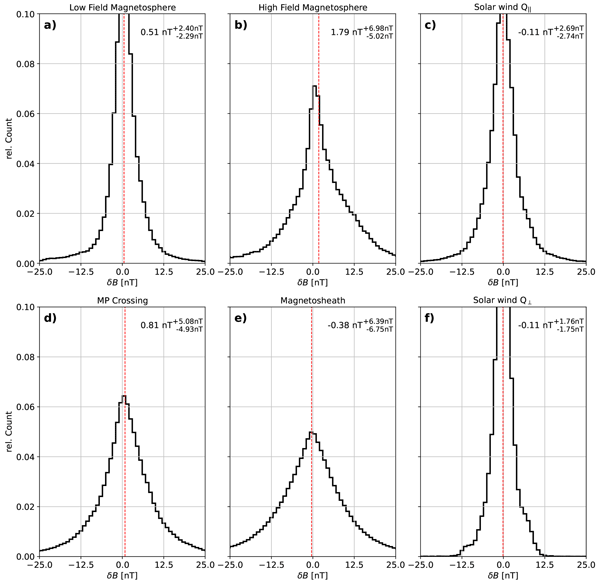
The Time History of Events and Macroscale Interactions during Substorms mission studies how the solar wind interacts with Earth’s magnetic field using five rotating spacecraft. After one spacecraft lost its measurements along its rotation axis, we used the two remaining magnetometer components with the spacecraft's spin to reconstruct the missing component with lower time resolution. A comparison with earlier data, when all components were available, shows that reconstruction is possible.
Raphael Steinhöfler, Marius Anger, Roman Shalamov, Jaan Praks, David Fischer, Werner Magnes, Josef Wilfinger, Aris Valavanoglou, and Constant Michel Felix Lentz
EGUsphere, https://doi.org/10.5194/egusphere-2026-1579, https://doi.org/10.5194/egusphere-2026-1579, 2026
Short summary
Short summary
This study investigates concepts of measuring magnetic fields with CubeSats. An exemplary instrument including the sensor, electronics, and boom was designed, built and tested. A novel Application-Specific Integrated Circuit has been used and concepts of larger missions have been adapted. Tests have shown the radiation hardness of the electronics and an improved performance over existing concepts. The results validate the technology and set further directions of CubeSat instrument developments.
Adrian T. LaMoury, Leonard Schulz, Alexander Betzler, David Hercik, Hans-Ulrich Auster, Patrick Brown, Werner Magnes, Christoph Amtmann, Richard Baughen, Hao Cao, Irmgard Jernej, Roland Lammegger, Adam Masters, Ferdinand Plaschke, Xun Yu, Taylor Pomfret, Alex Strickland, Vaibhav Garg, and Michele K. Dougherty
EGUsphere, https://doi.org/10.5194/egusphere-2026-2054, https://doi.org/10.5194/egusphere-2026-2054, 2026
Short summary
Short summary
The ESA Jupiter Icy Moons Explorer (Juice) mission flew past Earth and the Moon in August 2024, and this provided an opportunity to test the scientific instruments onboard the spacecraft. Here we show the measurements made by the Juice magnetometer, J-MAG, which measures the magnetic field in space. By comparing J-MAG observations with data from other spacecraft, we find that all parts of the instrument are working extremely well at this early stage in the mission.
Lars Klingenstein, Niklas Grimmich, Yuri Y. Shprits, Adrian Pöppelwerth, and Ferdinand Plaschke
Ann. Geophys., 43, 835–854, https://doi.org/10.5194/angeo-43-835-2025, https://doi.org/10.5194/angeo-43-835-2025, 2025
Short summary
Short summary
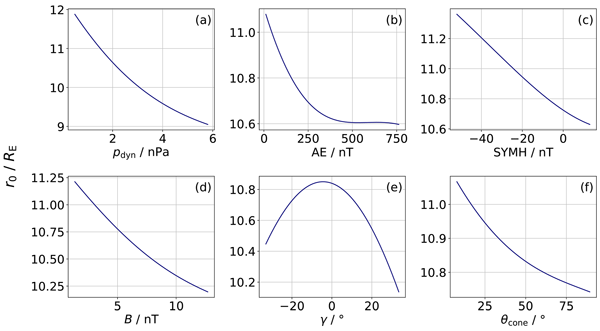
We applied machine learning to investigate how the solar wind and Earth's geomagnetic activity control the position of the magnetopause, the boundary layer of Earth's magnetic field. Our results demonstrate that geomagnetic activity strongly influences this boundary and should be incorporated in predictive models. Using data from multiple spacecraft, we developed a simple mathematical description of the magnetopause distance that improves understanding of solar wind–magnetosphere interactions.
Niklas Grimmich, Adrian Pöppelwerth, Martin Owain Archer, David Gary Sibeck, Ferdinand Plaschke, Wenli Mo, Vicki Toy-Edens, Drew Lawson Turner, Hyangpyo Kim, and Rumi Nakamura
Ann. Geophys., 43, 151–173, https://doi.org/10.5194/angeo-43-151-2025, https://doi.org/10.5194/angeo-43-151-2025, 2025
Short summary
Short summary
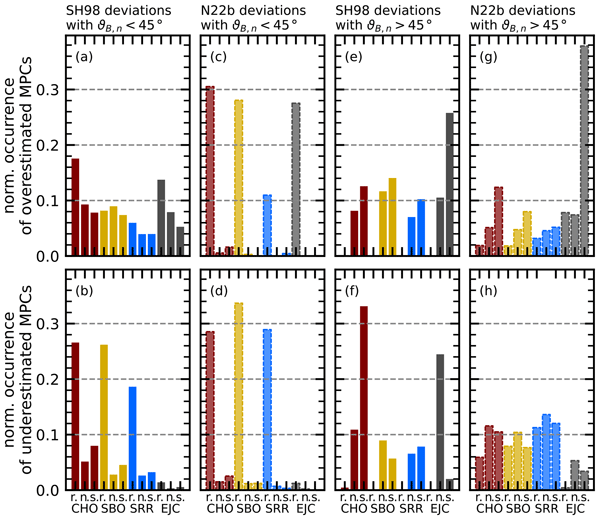
The boundary of Earth's magnetic field, the magnetopause, deflects and reacts to the solar wind, the energetic particles emanating from the Sun. We find that certain types of solar wind favour the occurrence of deviations between the magnetopause locations observed by spacecraft and those predicted by models. In addition, the turbulent region in front of the magnetopause, the foreshock, has a large influence on the location of the magnetopause and thus on the accuracy of the model predictions.
Niklas Grimmich, Ferdinand Plaschke, Benjamin Grison, Fabio Prencipe, Christophe Philippe Escoubet, Martin Owain Archer, Ovidiu Dragos Constantinescu, Stein Haaland, Rumi Nakamura, David Gary Sibeck, Fabien Darrouzet, Mykhaylo Hayosh, and Romain Maggiolo
Ann. Geophys., 42, 371–394, https://doi.org/10.5194/angeo-42-371-2024, https://doi.org/10.5194/angeo-42-371-2024, 2024
Short summary
Short summary
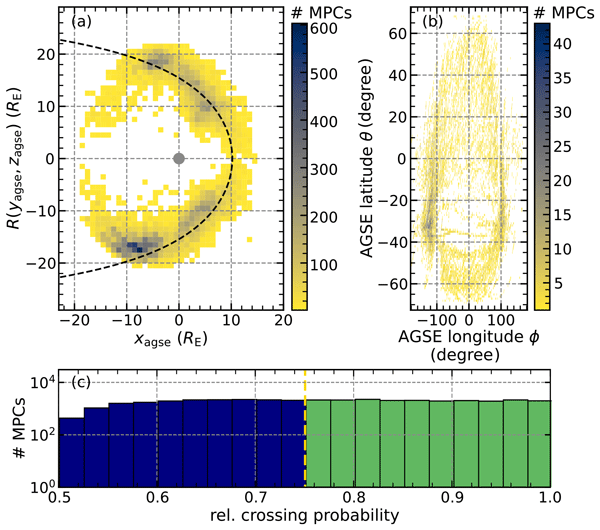
In our study, we looked at the boundary between the Earth's magnetic field and the interplanetary magnetic field emitted by the Sun, called the magnetopause. While other studies focus on the magnetopause motion near Earth's Equator, we have studied it in polar regions. The motion of the magnetopause is faster towards the Earth than towards the Sun. We also found that the occurrence of unusual magnetopause locations is due to similar solar influences in the equatorial and polar regions.
Adrian Pöppelwerth, Georg Glebe, Johannes Z. D. Mieth, Florian Koller, Tomas Karlsson, Zoltán Vörös, and Ferdinand Plaschke
Ann. Geophys., 42, 271–284, https://doi.org/10.5194/angeo-42-271-2024, https://doi.org/10.5194/angeo-42-271-2024, 2024
Short summary
Short summary
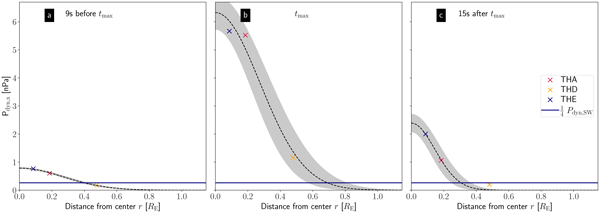
In the magnetosheath, a near-Earth region of space, we observe increases in plasma velocity and density, so-called jets. As they propagate towards Earth, jets interact with the ambient plasma. We study this interaction with three spacecraft simultaneously to infer their sizes. While previous studies have investigated their size almost exclusively statistically, we demonstrate a new method of determining the sizes of individual jets.
Tomas Karlsson, Ferdinand Plaschke, Austin N. Glass, and Jim M. Raines
Ann. Geophys., 42, 117–130, https://doi.org/10.5194/angeo-42-117-2024, https://doi.org/10.5194/angeo-42-117-2024, 2024
Short summary
Short summary
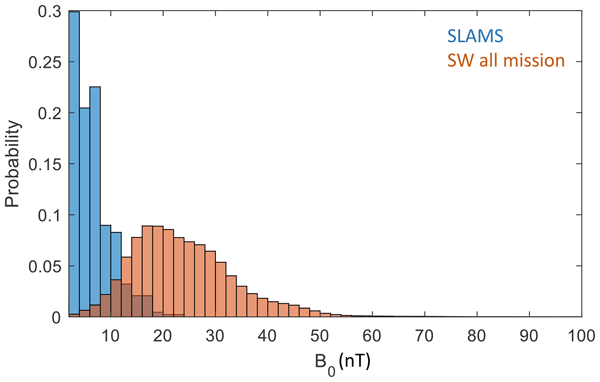
The solar wind interacts with the planets in the solar system and creates a supersonic shock in front of them. The upstream region of this shock contains many complicated phenomena. One such phenomenon is small-scale structures of strong magnetic fields (SLAMS). These SLAMS have been observed at Earth and are important in determining the properties of space around the planet. Until now, SLAMS have not been observed at Mercury, but we show for the first time that SLAMS also exist there.
Leonard Schulz, Karl-Heinz Glassmeier, Ferdinand Plaschke, Simon Toepfer, and Uwe Motschmann
Ann. Geophys., 41, 449–463, https://doi.org/10.5194/angeo-41-449-2023, https://doi.org/10.5194/angeo-41-449-2023, 2023
Short summary
Short summary
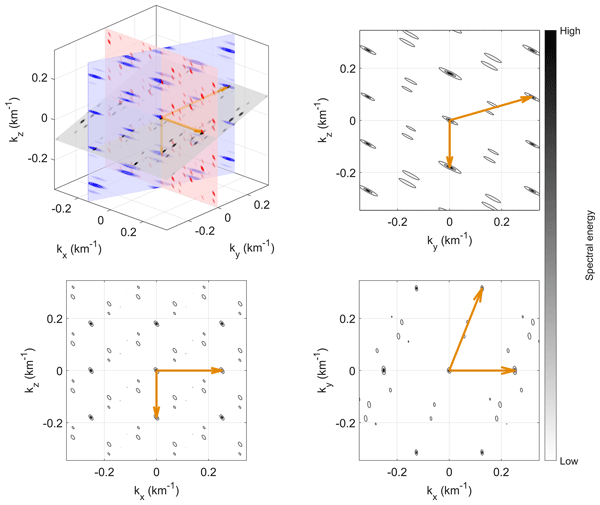
The upper detection limit in reciprocal space, the spatial Nyquist limit, is derived for arbitrary spatial dimensions for the wave telescope analysis technique. This is important as future space plasma missions will incorporate larger numbers of spacecraft (>4). Our findings are a key element in planning the spatial distribution of future multi-point spacecraft missions. The wave telescope is a multi-dimensional power spectrum estimator; hence, this can be applied to other fields of research.
Cited articles
Alexandrova, O., Saur, J., Lacombe, C., Mangeney, A., Mitchell, J., Schwartz, S. J., and Robert, P.: Universality of solar-wind turbulent spectrum from MHD to electron scales, Phys. Rev. Lett., 103, 165003, https://doi.org/10.1103/PhysRevLett.103.165003, 2009. a
Alexandrova, O., Lacombe, C., Mangeney, A., Grappin, R., and Maksimovic, M.: Solar wind turbulent spectrum at plasma kinetic scales, Astrophys. J., 760, 121, https://doi.org/10.1088/0004-637X/760/2/121, 2012. a, b
Alexandrova, O., Chen, C. H. K., Sorriso-Valvo, L., Horbury, T. S., and Bale, S. D.: Solar wind turbulence and the role of ion instabilities, Space Sci. Rev., 178, 101–139, https://doi.org/10.1007/s11214-013-0004-8, 2013. a, b
Angelopoulos, V.: The THEMIS Mission, Space Sci. Rev., 141, 5, https://doi.org/10.1007/s11214-008-9336-1, 2008. a
Auster, H. U. and Timmermann, G.: FGM data set, Zenodo [data set], https://doi.org/10.5281/zenodo.15774337, 2025. a
Auster, H. U., Apathy, I., Berghofer, G., Remizov, A., Roll, R., Fornacon, K. H., Glassmeier, K. H., Haerendel, G., Hejja, I., Kührt, E., Magnes, W., Moehlmann, D., Motschmann, U., Richter, I., Rosenbauer, H., Russell, C. T., Rustenbach, J., Sauer, K., Schwingenschuh, K., Szemerey, I., and Waesch, R.: ROMAP: Rosetta magnetometer and plasma monitor, Space Sci. Rev., 128, 221–240, https://doi.org/10.1007/s11214-006-9033-x, 2007. a
Auster, H. U., Glassmeier, K. H., Magnes, W., Aydogar, O., Baumjohann, W., Constantinescu, D., Fischer, D., Fornacon, K. H., Georgescu, E., Harvey, P., Hillenmaier, O., Kroth, R., Ludlam, M., Narita, Y., Nakamura, R., Okrafka, K., Plaschke, F., Richter, I., Schwarzl, H., Stoll, B., Valavanoglou, A., and Wiedemann, M.: The THEMIS fluxgate magnetometer, Space Sci. Rev., 141, 235–264, https://doi.org/10.1007/s11214-008-9365-9, 2008. a, b, c
Balogh, A., Beek, T. J., Forsyth, R. J., Hedgecock, P. C., Marquedant, R. J., Smith, E. J., Southwood, D. J., and Tsurutani, B. T.: The magnetic field investigation on the ULYSSES mission – instrumentation and preliminary scientific results, Astronomy and Astrophysics Supplement Series, 92, 221–236, 1992. a
Balogh, A., Carr, C. M., Acuña, M. H., Dunlop, M. W., Beek, T. J., Brown, P., Fornacon, K.-H., Georgescu, E., Glassmeier, K.-H., Harris, J., Musmann, G., Oddy, T., and Schwingenschuh, K.: The Cluster Magnetic Field Investigation: overview of in-flight performance and initial results, Ann. Geophys., 19, 1207–1217, https://doi.org/10.5194/angeo-19-1207-2001, 2001. a, b
Behannon, K. W., Acuna, M. H., Burlaga, L. F., Lepping, R. P., Ness, N. F., and Neubauer, F. M.: Magnetic field experiment for Voyagers 1 and 2, Space Sci. Rev., 21, 235–257, https://doi.org/10.1007/BF00211541, 1977. a
Bennett, J. S., Vyhnalek, B. E., Greenall, H., Bridge, E. M., Gotardo, F., Forstner, S., Harris, G. I., Miranda, F. A., and Bowen, W. P.: Precision magnetometers for aerospace applications: a review, Sensors, 21, 5568, https://doi.org/10.3390/s21165568, 2021. a
Blanco-Cano, X., Le, G., and Russel, C. T.: Identification of foreshock waves with 3-s periods, J. Geophys. Res.-Space, 104, 4643–4656, https://doi.org/10.1029/1998JA900103, 1999. a
Borovsky, J. E.: The velocity and magnetic field fluctuations of the solar wind at 1 AU: statistical analysis of Fourier spectra and correlations with plasma properties, J. Geophys. Res.-Space, 117, https://doi.org/10.1029/2011JA017499, 2012. a, b
Brown, P. and the The J-MAG Instrument Team: The J-MAG Magnetometer: Instrument design, performance, and initial in-flight results., EGU General Assembly 2024, Vienna, Austria, 14–19 Apr 2024, EGU24-1750, https://doi.org/10.5194/egusphere-egu24-1750, 2024. a, b
Brown, P., Beek, T., Carr, C., O'Brien, H., Cupido, E., Oddy, T., and Horbury, T. S.: Magnetoresistive magnetometer for space science applications, Meas. Sci. Technol., 23, 025902, https://doi.org/10.1088/0957-0233/23/2/025902, 2012. a, b
Brown, P., Whiteside, B. J., Beek, T. J., Fox, P., Horbury, T. S., Oddy, T. M., Archer, M. O., Eastwood, J. P., Sanz-Hernández, D., Sample, J. G., Cupido, E., O'Brien, H., and Carr, C. M.: Space magnetometer based on an anisotropic magnetoresistive hybrid sensor, Rev. Sci. Instrum., 85, 125117, https://doi.org/10.1063/1.4904702, 2014. a
Burch, J. L., Moore, T. E., Torbert, R. B., and Giles, B. L.: Magnetospheric multiscale overview and science objectives, Space Sci. Rev., 199, 5–21, https://doi.org/10.1007/s11214-015-0164-9, 2016. a
Dougherty, M. K., Kellock, S., Southwood, D. J., Balogh, A., Smith, E. J., Tsurutani, B. T., Gerlach, B., Glassmeier, K.-H., Gleim, F., Russell, C. T., Erdos, G., Neubauer, F. M., and Cowley, S. W. H.: The Cassini magnetic field investigation, Space Sci. Rev., 114, 331–383, https://doi.org/10.1007/s11214-004-1432-2, 2004. a
Eastwood, J. P., Balogh, A., Lucek, E. A., Mazelle, C., and Dandouras, I.: Quasi-monochromatic ULF foreshock waves as observed by the four-spacecraft Cluster mission: 1. Statistical properties, J. Geophys. Res.-Space, 110, https://doi.org/10.1029/2004JA010617, 2005. a
European Space Agency: FGM fluxgate magnetometer, Cluster Science Archive [data set], https://doi.org/10.5270/esa-hxcrsz5, 2025. a
Fischer, D., Magnes, W., Hagen, C., Dors, I., Chutter, M. W., Needell, J., Torbert, R. B., Le Contel, O., Strangeway, R. J., Kubin, G., Valavanoglou, A., Plaschke, F., Nakamura, R., Mirioni, L., Russell, C. T., Leinweber, H. K., Bromund, K. R., Le, G., Kepko, L., Anderson, B. J., Slavin, J. A., and Baumjohann, W.: Optimized merging of search coil and fluxgate data for MMS, Geosci. Instrum. Method. Data Syst., 5, 521–530, https://doi.org/10.5194/gi-5-521-2016, 2016. a
Grison, B. and Timmermann, G.: EMIC data set, Zenodo [data set], https://doi.org/10.5281/zenodo.15755257, 2025. a
Grison, B., Santolík, O., Lukačevič, J., and Usanova, M. E.: Occurrence of EMIC Waves in the magnetosphere according to their distance to the magnetopause, Geophys. Res. Lett., 48, e2020GL090921, https://doi.org/10.1029/2020GL090921, 2021. a
Heyner, D., Auster, H.-U., Fornaçon, K.-H., Carr, C., Richter, I., Mieth, J. Z. D., Kolhey, P., Exner, W., Motschmann, U., Baumjohann, W., Matsuoka, A., Magnes, W., Berghofer, G., Fischer, D., Plaschke, F., Nakamura, R., Narita, Y., Delva, M., Volwerk, M., Balogh, A., Dougherty, M., Horbury, T., Langlais, B., Mandea, M., Masters, A., Oliveira, J. S., Sánchez-Cano, B., Slavin, J. A., Vennerstrøm, S., Vogt, J., Wicht, J., and Glassmeier, K.-H.: The BepiColombo Planetary Magnetometer MPO-MAG: what can we learn from the Hermean magnetic field?, Space Sci. Rev., 217, 52, https://doi.org/10.1007/s11214-021-00822-x, 2021. a
Johnson, J. B.: Thermal agitation of electricity in conductors, Physical Review, 32, 97–109, https://doi.org/10.1103/PhysRev.32.97, 1928. a
Judge, D. L. and Coleman Jr., P. J.: Observations of low-frequency hydromagnetic waves in the distant geomagnetic field: Explorer 6, J. Geophys. Res., 67, 5071–5090, https://doi.org/10.1029/JZ067i013p05071, 1962. a
Karlsson, T., Plaschke, F., Glass, A. N., and Raines, J. M.: Short large-amplitude magnetic structures (SLAMS) at Mercury observed by MESSENGER, Ann. Geophys., 42, 117–130, https://doi.org/10.5194/angeo-42-117-2024, 2024. a
Klein, K. G., Spence, H., Alexandrova, O., Argall, M., Arzamasskiy, L., Bookbinder, J., Broeren, T., Caprioli, D., Case, A., Chandran, B., Chen, L.-J., Dors, I., Eastwood, J., Forsyth, C., Galvin, A., Genot, V., Halekas, J., Hesse, M., Hine, B., Horbury, T., Jian, L., Kasper, J., Kretzschmar, M., Kunz, M., Lavraud, B., Le Contel, O., Mallet, A., Maruca, B., Matthaeus, W., Niehof, J., O'Brien, H., Owen, C., Retinò, A., Reynolds, C., Roberts, O., Schekochihin, A., Skoug, R., Smith, C., Smith, S., Steinberg, J., Stevens, M., Szabo, A., TenBarge, J., Torbert, R., Vasquez, B., Verscharen, D., Whittlesey, P., Wickizer, B., Zank, G., and Zweibel, E.: HelioSwarm: a multipoint, multiscale mission to characterize turbulence, Space Sci. Rev., 219, 74, https://doi.org/10.1007/s11214-023-01019-0, 2023. a, b
Koller, F., Plaschke, F., Temmer, M., and Preisser, L.: THEMIS local and upstream magnetosheath jet data 2008–2020, Open Science Framework [data set], https://osf.io/6ywjz/ (last access: 3 Decemember 2025), 2021. a
Kolmogorov: The local structure of turbulence in incompressible viscous fluid for very large Reynolds numbers, P. Roy. Soc. A-Math. Phy., 434, 9–13, https://doi.org/10.1098/rspa.1991.0075, 1941. a
Korepanov, V., Berkman, R., Rakhlin, L., Klymovych, Y., Prystai, A., Marussenkov, A., and Afanassenko, M.: Advanced field magnetometers comparative study, Measurement, 29, 137–146, https://doi.org/10.1016/S0263-2241(00)00034-8, 2001. a
Laakso, H., Perry, C., McCaffrey, S., Herment, D., Allen, A. J., Harvey, C. C., Escoubet, C. P., Gruenberger, C., Taylor, M. G. G. T., and Turner, R.: Cluster active archive: overview, in: The Cluster Active Archive, edited by: Laakso, H., Taylor, M., and Escoubet, C. P., Vol. 11 of Astrophysics and Space Science Proceedings, Springer Netherlands, Dordrecht, https://doi.org/10.1007/978-90-481-3499-1_1, 3–37, 2010. a
Le, G., Russell, C. T., Thomsen, M. F., and Gosling, J. T.: Observations of a new class of upstream waves with periods near 3 seconds, J. Geophys. Res.-Space, 97, 2917–2925, https://doi.org/10.1029/91JA02707, 1992. a
Le Contel, O., Leroy, P., Roux, A., Coillot, C., Alison, D., Bouabdellah, A., Mirioni, L., Meslier, L., Galic, A., Vassal, M. C., Torbert, R. B., Needell, J., Rau, D., Dors, I., Ergun, R. E., Westfall, J., Summers, D., Wallace, J., Magnes, W., Valavanoglou, A., Olsson, G., Chutter, M., Macri, J., Myers, S., Turco, S., Nolin, J., Bodet, D., Rowe, K., Tanguy, M., and de la Porte, B.: The search-coil magnetometer for MMS, Space Sci. Rev., 199, 257–282, https://doi.org/10.1007/s11214-014-0096-9, 2016. a
Leger, J.-M., Frattter, I., Jager, T., and Lalaurie, J.-C.: Swarm absolute scalar and vector magnetometer based on helium 4 optical pumping, Procedia Chemistry, https://doi.org/10.1016/j.proche.2009.07.158, 2009. a
Leitner, S., Valavanoglou, A., Brown, P., Hagen, C., Magnes, W., Whiteside, B. J., Carr, C. M., Delva, M., and Baumjohann, W.: Design of the magnetoresistive magnetometer for ESA's SOSMAG project, IEEE Transactions on Magnetics, 51, 1–4, https://doi.org/10.1109/TMAG.2014.2358270, 2015. a, b, c
Magnes, W., Lammegger, R., Pollinger, A., Ellmeier, M., Hagen, C., Jernej, I., Windholz, L., and Baumjohann, W.: Space qualification of a new scalar magnetometer, EGU General Assembly 2013, EGU2013-9600-1, 2013. a
Magnes, W., Hillenmaier, O., Auster, H.-U., Brown, P., Kraft, S., Seon, J., Delva, M., Valavanoglou, A., Leitner, S., Fischer, D., Berghofer, G., Narita, Y., Plaschke, F., Volwerk, M., Wilfinger, J., Strauch, C., Ludwig, J., Constantinescu, D., Fornacon, K.-H., Gebauer, K., Hercik, D., Richter, I., Eastwood, J. P., Luntama, J. P., Hilgers, A., Heil, M., Na, G. W., and Lee, C. H.: Space weather magnetometer aboard GEO-KOMPSAT-2A, Space Sci. Rev., 216, 119, https://doi.org/10.1007/s11214-020-00742-2, 2020. a, b, c, d
Neubert, T., Mandea, M., Hulot, G., von Frese, R., Primdahl, F., Jørgensen, J. L., Friis-Christensen, E., Stauning, P., Olsen, N., and Risbo, T.: Ørsted satellite captures high-precision geomagnetic field data, EOS T. Am. Geophys. Un., 82, 81–88, https://doi.org/10.1029/01EO00043, 2001. a
Plaschke, F., Hietala, H., Archer, M., Blanco-Cano, X., Kajdič, P., Karlsson, T., Lee, S. H., Omidi, N., Palmroth, M., Roytershteyn, V., Schmid, D., Sergeev, V., and Sibeck, D.: Jets downstream of collisionless shocks, Space Sci. Rev., 214, 81, https://doi.org/10.1007/s11214-018-0516-3, 2018. a
Plaschke, F., Auster, H.-U., Fischer, D., Fornaçon, K.-H., Magnes, W., Richter, I., Constantinescu, D., and Narita, Y.: Advanced calibration of magnetometers on spin-stabilized spacecraft based on parameter decoupling, Geosci. Instrum. Method. Data Syst., 8, 63–76, https://doi.org/10.5194/gi-8-63-2019, 2019. a
Pollinger, A., Lammegger, R., Magnes, W., Hagen, C., Ellmeier, M., Jernej, I., Leichtfried, M., Kürbisch, C., Maierhofer, R., Wallner, R., Fremuth, G., Amtmann, C., Betzler, A., Delva, M., Prattes, G., and Baumjohann, W.: Coupled dark state magnetometer for the China Seismo-Electromagnetic Satellite, Meas. Sci. Technol., 29, 095103, https://doi.org/10.1088/1361-6501/aacde4, 2018. a, b
Pöppelwerth, A., Glebe, G., Mieth, J. Z. D., Koller, F., Karlsson, T., Vörös, Z., and Plaschke, F.: Scale size estimation and flow pattern recognition around a magnetosheath jet, Ann. Geophys., 42, 271–284, https://doi.org/10.5194/angeo-42-271-2024, 2024. a
Qiu, F., Wang, J., Zhang, Y., Yang, G., and Weng, C.: Resolution limit of anisotropic magnetoresistance(AMR) based vector magnetometer, Sensors and Actuators A: Physical, 280, 61–67, https://doi.org/10.1016/j.sna.2018.07.031, 2018. a
Rakhmanova, L., Riazantseva, M., Zastenker, G., and Yermolaev, Y.: Role of the variable solar wind in the dynamics of small-scale magnetosheath structures, Frontiers in Astronomy and Space Sciences, 10, https://doi.org/10.3389/fspas.2023.1121230, 2023. a
Roberts, O. W., Klein, K. G., Vörös, Z., Nakamura, R., Li, X., Narita, Y., Schmid, D., Bandyopadhyay, R., and Matthaeus, W. H.: Measurement of the Taylor microscale and the effective magnetic Reynolds number in the solar wind with cluster, J. Geophys. Res.-Space, 129, e2024JA032968, https://doi.org/10.1029/2024JA032968, 2024. a
Roux, A., Le Contel, O., Coillot, C., Bouabdellah, A., de la Porte, B., Alison, D., Ruocco, S., and Vassal, M. C.: The search coil magnetometer for THEMIS, Space Sci. Rev., 141, 265–275, https://doi.org/10.1007/s11214-008-9455-8, 2008. a
Russell, C. T., Snare, R. C., Means, J. D., and Elphic, R. C.: Pioneer Venus orbiter fluxgate magnetometer, IEEE T. Geosci. Remote, GE-18, 32–35, https://doi.org/10.1109/TGRS.1980.350256, 1980. a
Schulz, L., Heinisch, P., and Richter, I.: Calibration of off-the-shelf anisotropic magnetoresistance magnetometers, Sensors, 19, https://doi.org/10.3390/s19081850, 2019. a
Schwartz, S. J. and Burgess, D.: Quasi-parallel shocks: a patchwork of three-dimensional structures, Geophys. Res. Lett., 18, 373–376, https://doi.org/10.1029/91GL00138, 1991. a
SciPy: welch – SciPy v1.15.3 Manual, https://docs.scipy.org/doc/scipy/reference/generated/scipy.signal.welch.html#scipy.signal.welch (last access: 3 December 2025), 2025. a
Stürner, F. M., Brenneis, A., Kassel, J., Wostradowski, U., Rölver, R., Fuchs, T., Nakamura, K., Sumiya, H., Onoda, S., Isoya, J., and Jelezko, F.: Compact integrated magnetometer based on nitrogen-vacancy centres in diamond, Diamond and Related Materials, 93, 59–65, https://doi.org/10.1016/j.diamond.2019.01.008, 2019. a
Timmermann, G.: GEO data set, Zenodo [data set], https://doi.org/10.5281/zenodo.15755309, 2025a. a
Timmermann, G.: Magnetosheath data set, Zenodo [data set], https://doi.org/10.5281/zenodo.15755176, 2025b. a
Timmermann, G.: Solar Wind data set, Zenodo [data set], https://doi.org/10.5281/zenodo.15796214, 2025c. a
Torbert, R. B., Russell, C. T., Magnes, W., Ergun, R. E., Lindqvist, P.-A., LeContel, O., Vaith, H., Macri, J., Myers, S., Rau, D., Needell, J., King, B., Granoff, M., Chutter, M., Dors, I., Olsson, G., Khotyaintsev, Y. V., Eriksson, A., Kletzing, C. A., Bounds, S., Anderson, B., Baumjohann, W., Steller, M., Bromund, K., Le, G., Nakamura, R., Strangeway, R. J., Leinweber, H. K., Tucker, S., Westfall, J., Fischer, D., Plaschke, F., Porter, J., and Lappalainen, K.: The FIELDS instrument suite on MMS: scientific objectives, measurements, and data products, Space Sci. Rev., 199, 105–135, https://doi.org/10.1007/s11214-014-0109-8, 2016. a, b
Tsurutani, B. T., Lakhina, G. S., Verkhoglyadova, O. P., Echer, E., and Guarnieri, F. L.: Magnetic Decreases (MDs) and mirror modes: two different plasma β changing mechanisms, Nonlin. Processes Geophys., 17, 467–479, https://doi.org/10.5194/npg-17-467-2010, 2010. a
Usanova, M. E., Mann, I. R., Bortnik, J., Shao, L., and Angelopoulos, V.: THEMIS observations of electromagnetic ion cyclotron wave occurrence: dependence on AE, SYMH, and solar wind dynamic pressure, J. Geophys. Res.-Space, 117, https://doi.org/10.1029/2012JA018049, 2012. a, b
Valavanoglou, A. and Timmermann, G.: AMR data set, Zenodo [data set], https://doi.org/10.5281/zenodo.15755038, 2025. a
Viall, N. M., DeForest, C. E., and Kepko, L.: Mesoscale structure in the solar wind, Frontiers in Astronomy and Space Sciences, 8, https://doi.org/10.3389/fspas.2021.735034, 2021. a
Volwerk, M., Glassmeier, K.-H., Delva, M., Schmid, D., Koenders, C., Richter, I., and Szegö, K.: A comparison between VEGA 1, 2 and Giotto flybys of comet 1P/Halley: implications for Rosetta, Ann. Geophys., 32, 1441–1453, https://doi.org/10.5194/angeo-32-1441-2014, 2014. a
Vörös, Z., Yordanova, E., Echim, M. M., Consolini, G., and Narita, Y.: Turbulence-generated proton-scale structures in the terrestrial magnetosheath, Astrophys. J., 819, L15, https://doi.org/10.3847/2041-8205/819/1/L15, 2016. a
Vörös, Z., Yordanova, E., Varsani, A., Genestreti, K. J., Khotyaintsev, Y. V., Li, W., Graham, D. B., Norgren, C., Nakamura, R., Narita, Y., Plaschke, F., Magnes, W., Baumjohann, W., Fischer, D., Vaivads, A., Eriksson, E., Lindqvist, P.-A., Marklund, G., Ergun, R. E., Leitner, M., Leubner, M. P., Strangeway, R. J., Le Contel, O., Pollock, C., Giles, B. J., Torbert, R. B., Burch, J. L., Avanov, L. A., Dorelli, J. C., Gershman, D. J., Paterson, W. R., Lavraud, B., and Saito, Y.: MMS observation of magnetic reconnection in the turbulent magnetosheath, J. Geophys. Res.-Space, 122, 11442–11467, https://doi.org/10.1002/2017JA024535, 2017. a
Webb, J. L., Clement, J. D., Troise, L., Ahmadi, S., Johansen, G. J., Huck, A., and Andersen, U. L.: Nanotesla sensitivity magnetic field sensing using a compact diamond nitrogen-vacancy magnetometer, Applied Physics Letters, 114, 231103, https://doi.org/10.1063/1.5095241, 2019. a
Welch, P.: The use of fast Fourier transform for the estimation of power spectra: a method based on time averaging over short, modified periodograms, IEEE Transactions on Audio and Electroacoustics, 15, 70–73, https://doi.org/10.1109/TAU.1967.1161901, 1967. a
Short summary
We've compared the amplitude spectral densities of a fluxgate magnetometer (FGM) and an anisotropic magnetoresistive (AMR) magnetometer during ground testing with the amplitude spectral densities obtained in different regions of near-Earth space. The FGM can measure the fields in the different space regions and their fluctuations within a frequency range of 1 mHz to 2.5 Hz. The AMR magnetometer is only suitable for more turbulent regions such as the magnetosheath due to its higher noise levels.
We've compared the amplitude spectral densities of a fluxgate magnetometer (FGM) and an...


