
Articles | Volume 14, issue 2
https://doi.org/10.5194/gi-14-459-2025
© Author(s) 2025. This work is distributed under
the Creative Commons Attribution 4.0 License.
the Creative Commons Attribution 4.0 License.
https://doi.org/10.5194/gi-14-459-2025
© Author(s) 2025. This work is distributed under
the Creative Commons Attribution 4.0 License.
the Creative Commons Attribution 4.0 License.
Research article
| 
10 Dec 2025
Research article |
| 10 Dec 2025
| 10 Dec 2025
Ice borehole thermometry: sensor placement using greedy optimal sampling

Alfred Wegener Institute, Helmholtz Centre for Polar and Marine Research, Potsdam, Germany
School of Mathematics and Natural Sciences, Bergische Universität Wuppertal, Wuppertal, Germany
Thomas Laepple
Alfred Wegener Institute, Helmholtz Centre for Polar and Marine Research, Potsdam, Germany
MARUM Center for Marine Environmental Sciences, University of Bremen, Bremen, Germany
Department of Geosciences, University of Bremen, Bremen, Germany
Nora Hirsch
Alfred Wegener Institute, Helmholtz Centre for Polar and Marine Research, Potsdam, Germany
Department of Geosciences, University of Bremen, Bremen, Germany
Peter Zaspel
School of Mathematics and Natural Sciences, Bergische Universität Wuppertal, Wuppertal, Germany
Related authors
No articles found.
Adrien Ooms, Mathieu Casado, Sonja Wahl, Thomas Laepple, Alexandra Zuhr, Pete Akers, Ghislain Picard, Laurent Arnaud, Joel Savarino, Kira Rehfeld, Barbara Stenni, Giuliano Dreossi, Mauro Masiol, Amaelle Landais, and Valérie Masson-Delmotte
EGUsphere, https://doi.org/10.5194/egusphere-2026-4801, https://doi.org/10.5194/egusphere-2026-4801, 2026
This preprint is open for discussion and under review for Climate of the Past (CP).
Short summary
Short summary
This work presents new insights in the archival process of multi-annual climatic signal in the near surface firn at Concordia Station, East-Antarctica, from the new data set of high resolution stable water isotope profiles measured in a snow trench. The dated isotopic profiles covering 20 years are compared against overlapping precipitation and surface snow observations. This highlights the strong contribution of stratigraphic noise and post depositional effects to individual trench profiles.
Fyntan Shaw, Torben Kunz, and Thomas Laepple
EGUsphere, https://doi.org/10.5194/egusphere-2026-3558, https://doi.org/10.5194/egusphere-2026-3558, 2026
Short summary
Short summary
Estimates of water isotope diffusion lengths in ice cores are used to correct signal loss and infer past firn temperatures, but require accurate spectral fitting. Existing methods neglect effects from discrete sampling, causing an estimation bias which we demonstrate grows with sampling interval and decreasing diffusion length. By incorporating sampling effects into the model fit, we derive an unbiased estimator that improves estimates from coarse data and ice cores with small diffusion lengths.
Jannis Viola, Lars Wörmer, Kai-Uwe Hinrichs, and Thomas Laepple
Clim. Past, 22, 1023–1036, https://doi.org/10.5194/cp-22-1023-2026, https://doi.org/10.5194/cp-22-1023-2026, 2026
Short summary
Short summary
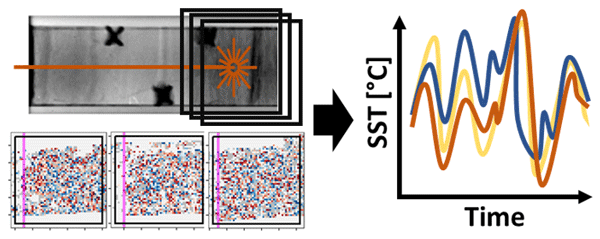
This study used mass spectrometry imaging (MSI) to detect spatial patterns of biomarkers used for sea surface temperature (SST) reconstructions. The observed proxy heterogeneity was bigger than expected within layered marine sediments. The data was used to estimate the climate signal content of individual MSI based reconstructions. The results can be used to inform sampling decisions or to derive uncertainty estimates for high-resolution SST reconstructions and climate variability estimates.
Mara Y. McPartland, Thomas Münch, Andrew M. Dolman, Raphaël Hébert, and Thomas Laepple
Clim. Past, 21, 1917–1931, https://doi.org/10.5194/cp-21-1917-2025, https://doi.org/10.5194/cp-21-1917-2025, 2025
Short summary
Short summary
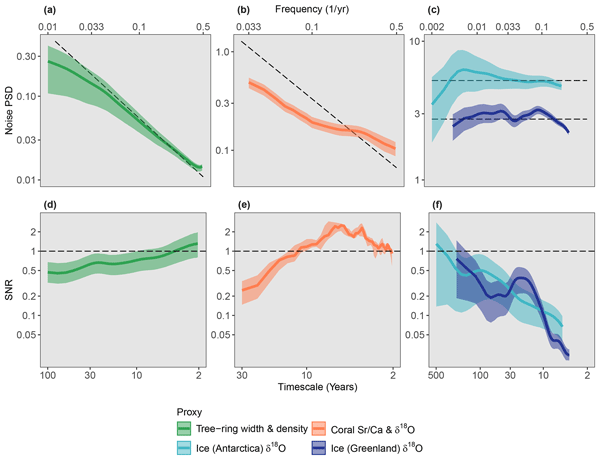
Paleoclimate proxy records contain a combination of climate signals and non-climatic noise. This noise can affect year-to-year variations, or introduce uncertainty on medium and long timescales. Proxies contain different types, or "colors" of noise stemming from the diverse physical and biological processes that go into their creation. We show how non-climatic noise affects tree rings, corals and ice cores. We aim to improve representations of noise in paleoclimate research activities.
Fyntan Shaw, Thomas Münch, Vasileios Gkinis, and Thomas Laepple
The Cryosphere, 19, 4913–4928, https://doi.org/10.5194/tc-19-4913-2025, https://doi.org/10.5194/tc-19-4913-2025, 2025
Short summary
Short summary
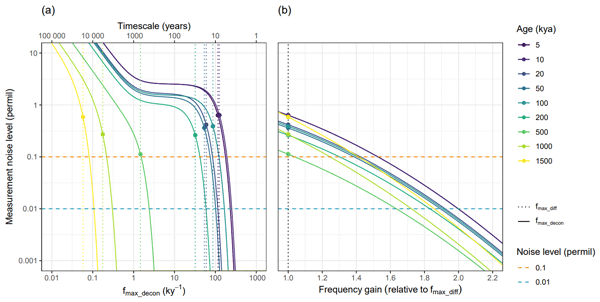
Diffusion in combination with measurement noise erase high-frequency water isotope variability in ice cores, linking measurement precision to recoverable resolution. We derive expressions for this relationship, finding a resolution improvement of 1.5 times for a 10-fold measurement noise reduction. Based on the current age-depth model, our method predicts 10 000-year cycles will be recoverable in the 1.5 Myr old ice from the Oldest Ice Core δ18O record if a noise level of 0.01 ‰ is achieved.
Laura Schild, Peter Ewald, Chenzhi Li, Raphaël Hébert, Thomas Laepple, and Ulrike Herzschuh
Earth Syst. Sci. Data, 17, 2007–2033, https://doi.org/10.5194/essd-17-2007-2025, https://doi.org/10.5194/essd-17-2007-2025, 2025
Short summary
Short summary
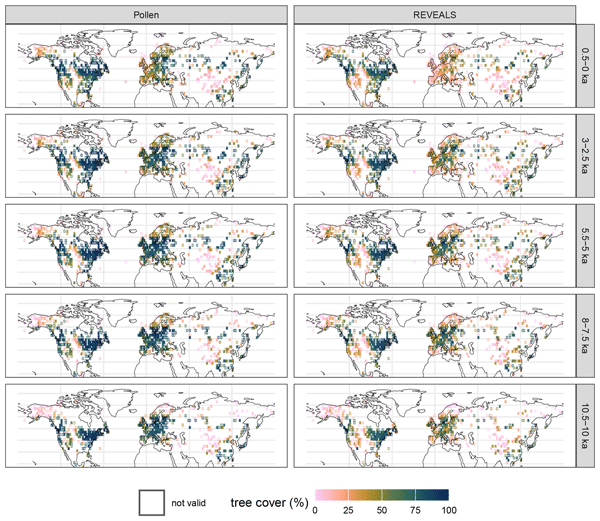
This study reconstructed vegetation and tree cover in the Northern Hemisphere from a harmonized dataset of pollen counts from sediment and peat cores for the past 14 000 years. A model was applied to correct for differences in pollen production between different plants, and modern remote-sensing forest cover was used to validate the reconstructed tree cover. Accurate data on past vegetation are invaluable for the investigation of vegetation–climate dynamics and the validation of vegetation models.
Rémi Dallmayr, Hannah Meyer, Vasileios Gkinis, Thomas Laepple, Melanie Behrens, Frank Wilhelms, and Maria Hörhold
The Cryosphere, 19, 1067–1083, https://doi.org/10.5194/tc-19-1067-2025, https://doi.org/10.5194/tc-19-1067-2025, 2025
Short summary
Short summary
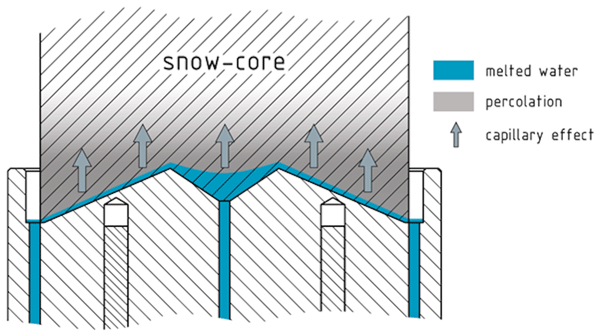
Recent studies showed that a large number of independent vertical profiles allow for inferring a common local climate signal from the stacked stable water isotope record. Through investigating instrumental limitation and the effect of percolation of such porous samples, this study assesses the continuous flow analysis (CFA) technique in order to analyze the significant number of snow surface profiles within a reasonable time and with high quality.
Fyntan Shaw, Andrew M. Dolman, Torben Kunz, Vasileios Gkinis, and Thomas Laepple
The Cryosphere, 18, 3685–3698, https://doi.org/10.5194/tc-18-3685-2024, https://doi.org/10.5194/tc-18-3685-2024, 2024
Short summary
Short summary
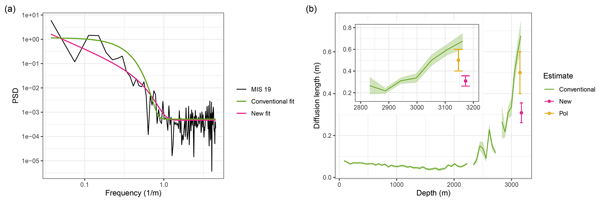
Fast variability of water isotopes in ice cores is attenuated by diffusion but can be restored if the diffusion length is accurately estimated. Current estimation methods are inadequate for deep ice, mischaracterising millennial-scale climate variability. We address this using variability estimates from shallower ice. The estimated diffusion length of 31 cm for the bottom of the Dome C ice core is 20 cm less than the old method, enabling signal recovery on timescales previously considered lost.
Alexandra M. Zuhr, Sonja Wahl, Hans Christian Steen-Larsen, Maria Hörhold, Hanno Meyer, Vasileios Gkinis, and Thomas Laepple
Earth Syst. Sci. Data, 16, 1861–1874, https://doi.org/10.5194/essd-16-1861-2024, https://doi.org/10.5194/essd-16-1861-2024, 2024
Short summary
Short summary
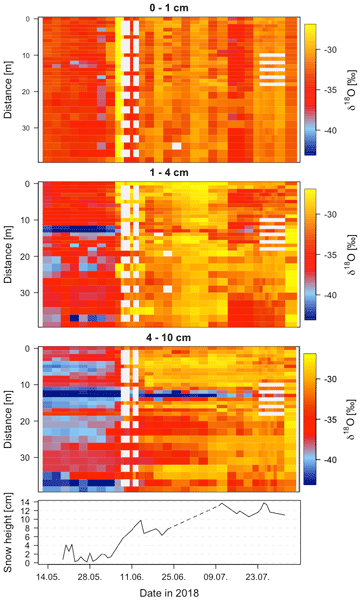
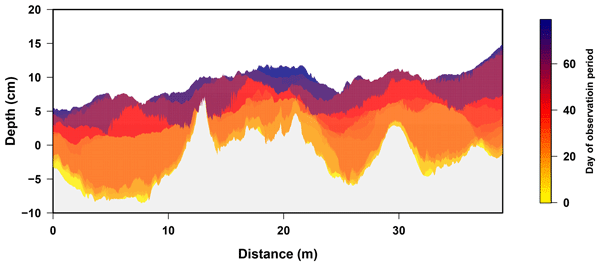
We present stable water isotope data from the accumulation zone of the Greenland ice sheet. A spatial sampling scheme covering 39 m and three depth layers was carried out between 14 May and 3 August 2018. The data suggest spatial and temporal variability related to meteorological conditions, such as wind-driven snow redistribution and vapour–snow exchange processes. The data can be used to study the formation of the stable water isotopes signal, which is seen as a climate proxy.
Nora Hirsch, Alexandra Zuhr, Thomas Münch, Maria Hörhold, Johannes Freitag, Remi Dallmayr, and Thomas Laepple
The Cryosphere, 17, 4207–4221, https://doi.org/10.5194/tc-17-4207-2023, https://doi.org/10.5194/tc-17-4207-2023, 2023
Short summary
Short summary
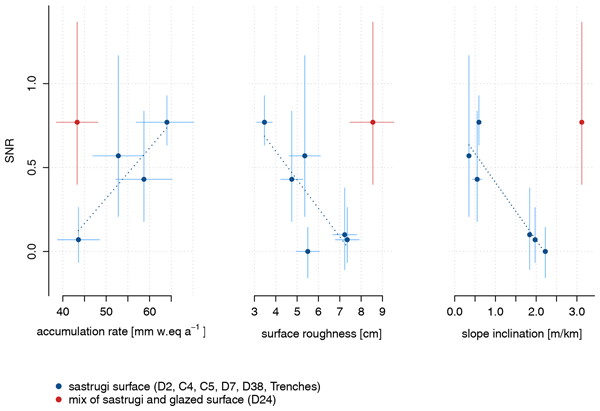
Stable water isotopes from firn cores provide valuable information on past climates, yet their utility is hampered by stratigraphic noise, i.e. the irregular deposition and wind-driven redistribution of snow. We found stratigraphic noise on the Antarctic Plateau to be related to the local accumulation rate, snow surface roughness and slope inclination, which can guide future decisions on sampling locations and thus increase the resolution of climate reconstructions from low-accumulation areas.

Antoine Grisart, Mathieu Casado, Vasileios Gkinis, Bo Vinther, Philippe Naveau, Mathieu Vrac, Thomas Laepple, Bénédicte Minster, Frederic Prié, Barbara Stenni, Elise Fourré, Hans Christian Steen-Larsen, Jean Jouzel, Martin Werner, Katy Pol, Valérie Masson-Delmotte, Maria Hoerhold, Trevor Popp, and Amaelle Landais
Clim. Past, 18, 2289–2301, https://doi.org/10.5194/cp-18-2289-2022, https://doi.org/10.5194/cp-18-2289-2022, 2022
Short summary
Short summary
This paper presents a compilation of high-resolution (11 cm) water isotopic records, including published and new measurements, for the last 800 000 years from the EPICA Dome C ice core, Antarctica. Using this new combined water isotopes (δ18O and δD) dataset, we study the variability and possible influence of diffusion at the multi-decadal to multi-centennial scale. We observe a stronger variability at the onset of the interglacial interval corresponding to a warm period.
Alexandra M. Zuhr, Thomas Münch, Hans Christian Steen-Larsen, Maria Hörhold, and Thomas Laepple
The Cryosphere, 15, 4873–4900, https://doi.org/10.5194/tc-15-4873-2021, https://doi.org/10.5194/tc-15-4873-2021, 2021
Short summary
Short summary
Firn and ice cores are used to infer past temperatures. However, the imprint of the climatic signal in stable water isotopes is influenced by depositional modifications. We present and use a photogrammetry structure-from-motion approach and find variability in the amount, the timing, and the location of snowfall. Depositional modifications of the surface are observed, leading to mixing of snow from different snowfall events and spatial locations and thus creating noise in the proxy record.
Cited articles
Andersson, T. R., Bruinsma, W. P., Markou, S., Requeima, J., Coca-Castro, A., Vaughan, A., Ellis, A.-L., Lazzara, M. A., Jones, D., Hosking, S., and Turner, R. E.: Environmental sensor placement with convolutional Gaussian neural processes, Environmental Data Science, 2, e32, https://doi.org/10.1017/eds.2023.22, 2023. a
Arthern, R. J., Vaughan, D. G., Rankin, A. M., Mulvaney, R., and Thomas, E. R.: In situ measurements of Antarctic snow compaction compared with predictions of models, Journal of Geophysical Research: Earth Surface, 115, https://doi.org/10.1029/2009JF001306, 2010. a
Bartos, M. and Kerkez, B.: Observability-Based Sensor Placement Improves Contaminant Tracing in River Networks, Water Resources Research, 57, https://doi.org/10.1029/2020WR029551, 2021. a
Beltrami, H.: Earth's Long-Term Memory, Science, 297, 206–207, https://doi.org/10.1126/science.1074027, 2002. a
Beltrami, H., Matharoo, G. S., and Smerdon, J. E.: Impact of borehole depths on reconstructed estimates of ground surface temperature histories and energy storage, Journal of Geophysical Research: Earth Surface, 120, 763–778, https://doi.org/10.1002/2014JF003382, 2015. a
Biskaborn, B. K., Smith, S. L., Noetzli, J., Matthes, H., Vieira, G., Streletskiy, D. A., Schoeneich, P., Romanovsky, V. E., Lewkowicz, A. G., Abramov, A., Allard, M., Boike, J., Cable, W. L., Christiansen, H. H., Delaloye, R., Diekmann, B., Drozdov, D., Etzelmüller, B., Grosse, G., Guglielmin, M., Ingeman-Nielsen, T., Isaksen, K., Ishikawa, M., Johansson, M., Johannsson, H., Joo, A., Kaverin, D., Kholodov, A., Konstantinov, P., Kröger, T., Lambiel, C., Lanckman, J.-P., Luo, D., Malkova, G., Meiklejohn, I., Moskalenko, N., Oliva, M., Phillips, M., Ramos, M., Sannel, A. B. K., Sergeev, D., Seybold, C., Skryabin, P., Vasiliev, A., Wu, Q., Yoshikawa, K., Zheleznyak, M., and Lantuit, H.: Permafrost is warming at a global scale, Nat. Commun., 10, 264, https://doi.org/10.1038/s41467-018-08240-4, 2019. a
Black, P. E.: Greedy algorithm, Dictionary of Algorithms and Data Structures, 2, 62, US National Institute of Standards and Technology, https://www.nist.gov/dads/HTML/greedyalgo.html (last access: 18 November 2025), 2005. a
Bolzan, J. F. and Strobel, M.: Accumulation-rate variations around Summit, Greenland, Journal of Glaciology, 40, 56–66, https://doi.org/10.3189/S0022143000003798, 1994. a
Casado, M., Münch, T., and Laepple, T.: Climatic information archived in ice cores: impact of intermittency and diffusion on the recorded isotopic signal in Antarctica, Clim. Past, 16, 1581–1598, https://doi.org/10.5194/cp-16-1581-2020, 2020. a
Clow, G. D.: The extent of temporal smearing in surface-temperature histories derived from borehole temperature measurements, Global and Planetary Change, 6, 81–86, https://doi.org/10.1016/0921-8181(92)90027-8, 1992. a, b, c
Clow, G. D., Saltus, R. W., and Waddington, E. D.: A new high-precision borehole-temperature logging system used at GISP2, Greenland, and Taylor Dome, Antarctica, Journal of Glaciology, 42, 576–584, https://doi.org/10.3189/S0022143000003555, 1996. a
Colgan, W., Shields, C., Talalay, P., Fan, X., Lines, A. P., Elliott, J., Rajaram, H., Mankoff, K., Jensen, M., Backes, M., Liu, Y., Wei, X., Karlsson, N. B., Spanggård, H., and Pedersen, A. Ø.: Design and performance of the Hotrod melt-tip ice-drilling system, Geosci. Instrum. Method. Data Syst., 12, 121–140, https://doi.org/10.5194/gi-12-121-2023, 2023. a
Compo, G., Whitaker, J., Sardeshmukh, P., Allan, R., McColl, C., Yin, X., Giese, B., Vose, R., Matsui, N., Ashcroft, L., Auchmann, R., Benoy, M., Bessemoulin, P., Brandsma, T., Brohan, P., Brunet, M., Comeaux, J., Cram, T., Crouthamel, R., Groisman, P., Hersbach, H., Jones, P., Jonsson, T., Jourdain, S., Kelly, G., Knapp, K., Kruger, A., Kubota, H., Lentini, G., Lorrey, A., Lott, N., Lubker, S., Luterbacher, J., Marshall, G., Maugeri, M., Mock, C., Mok, H., Nordli, O., Przybylak, R., Rodwell, M., Ross, T., Schuster, D., Srnec, L., Valente, M., Vizi, Z., Wang, X., Westcott, N., Woollen, J., and Worley, S.: NOAA/CIRES Twentieth Century Global Reanalysis Version 2c, NSF National Center for Atmospheric Research [data set], https://doi.org/10.5065/D6N877TW, 2015. a
Cuffey, K. M., Clow, G. D., Steig, E. J., Buizert, C., Fudge, T. J., Koutnik, M., Waddington, E. D., Alley, R. B., and Severinghaus, J. P.: Deglacial temperature history of West Antarctica, Proceedings of the National Academy of Sciences, 113, 14249–14254, https://doi.org/10.1073/pnas.1609132113, 2016. a
Eppelbaum, L. V.: The Possibility of Estimating the Permafrost's Porosity In Situ in the Hydrocarbon Industry and Environment, Geosciences, 14, 72, https://doi.org/10.3390/geosciences14030072, 2024. a
García-Pereira, F., González-Rouco, J. F., Schmid, T., Melo-Aguilar, C., Vegas-Cañas, C., Steinert, N. J., Roldán-Gómez, P. J., Cuesta-Valero, F. J., García-García, A., Beltrami, H., and de Vrese, P.: Thermodynamic and hydrological drivers of the soil and bedrock thermal regimes in central Spain, SOIL, 10, 1–21, https://doi.org/10.5194/soil-10-1-2024, 2024. a
Goujon, C., Barnola, J.-M., and Ritz, C.: Modeling the densification of polar firn including heat diffusion: Application to close-off characteristics and gas isotopic fractionation for Antarctica and Greenland sites, Journal of Geophysical Research: Atmospheres, 108, https://doi.org/10.1029/2002JD003319, 2003. a
Groenke, B., Langer, M., Miesner, F., Westermann, S., Gallego, G., and Boike, J.: Robust Reconstruction of Historical Climate Change From Permafrost Boreholes, Journal of Geophysical Research: Earth Surface, 129, e2024JF007734, https://doi.org/10.1029/2024JF007734, 2024. a, b
Hammer, C. U. and Dahl-Jensen, D.: GRIP Accumulation Rates, PANGAEA [data set], https://doi.org/10.1594/PANGAEA.55084, 1999. a, b
Hébert, R., Herzschuh, U., and Laepple, T.: Millennial-scale climate variability over land overprinted by ocean temperature fluctuations, Nat. Geosci., 15, 899–905, https://doi.org/10.1038/s41561-022-01056-4, 2022. a
Herron, M. M. and Langway Jr., C. C.: Firn Densification: An Empirical Model, Journal of Glaciology, 25, 373–385, https://doi.org/10.3189/S0022143000015239, 1980. a
Hersbach, H., Bell, B., Berrisford, P., Hirahara, S., Horányi, A., Muñoz-Sabater, J., Nicolas, J., Peubey, C., Radu, R., Schepers, D., Simmons, A., Soci, C., Abdalla, S., Abellan, X., Balsamo, G., Bechtold, P., Biavati, G., Bidlot, J., Bonavita, M., De Chiara, G., Dahlgren, P., Dee, D., Diamantakis, M., Dragani, R., Flemming, J., Forbes, R., Fuentes, M., Geer, A., Haimberger, L., Healy, S., Hogan, R. J., Hólm, E., Janisková, M., Keeley, S., Laloyaux, P., Lopez, P., Lupu, C., Radnoti, G., de Rosnay, P., Rozum, I., Vamborg, F., Villaume, S., and Thépaut, J.-N.: The ERA5 global reanalysis, Quarterly Journal of the Royal Meteorological Society, 146, 1999–2049, https://doi.org/10.1002/qj.3803, 2020. a
Johnsen, S. J.: GRIP Temperature Profile, PANGAEA [data set], https://doi.org/10.1594/PANGAEA.89007, 2003. a, b
Jones, J. M., Gille, S. T., Goosse, H., Abram, N. J., Canziani, P. O., Charman, D. J., Clem, K. R., Crosta, X., de Lavergne, C., Eisenman, I., England, M. H., Fogt, R. L., Frankcombe, L. M., Marshall, G. J., Masson-Delmotte, V., Morrison, A. K., Orsi, A. J., Raphael, M. N., Renwick, J. A., Schneider, D. P., Simpkins, G. R., Steig, E. J., Stenni, B., Swingedouw, D., and Vance, T. R.: Assessing recent trends in high-latitude Southern Hemisphere surface climate, Nature Climate Change, 6, 917–926, https://doi.org/10.1038/nclimate3103, 2016. a
Laepple, T. and Huybers, P.: Ocean surface temperature variability: Large model–data differences at decadal and longer periods, Proceedings of the National Academy of Sciences, 111, 16682–16687, https://doi.org/10.1073/pnas.1412077111, 2014. a
Lee, S.-y., Lee, I.-b., Yeo, U.-h., Kim, R.-w., and Kim, J.-g.: Optimal sensor placement for monitoring and controlling greenhouse internal environments, Biosystems Engineering, 188, 190–206, https://doi.org/10.1016/j.biosystemseng.2019.10.005, 2019. a
Ligtenberg, S. R. M., Helsen, M. M., and van den Broeke, M. R.: An improved semi-empirical model for the densification of Antarctic firn, The Cryosphere, 5, 809–819, https://doi.org/10.5194/tc-5-809-2011, 2011. a
Lliboutry, L.: A critical review of analytical approximate solutions for steady state velocities and temperature in cold ice-sheets,, Z. Gletscherkde. Glazialgeol, 15, 135–148, 1979. a
Løkkegaard, A., Mankoff, K. D., Zdanowicz, C., Clow, G. D., Lüthi, M. P., Doyle, S. H., Thomsen, H. H., Fisher, D., Harper, J., Aschwanden, A., Vinther, B. M., Dahl-Jensen, D., Zekollari, H., Meierbachtol, T., McDowell, I., Humphrey, N., Solgaard, A., Karlsson, N. B., Khan, S. A., Hills, B., Law, R., Hubbard, B., Christoffersen, P., Jacquemart, M., Seguinot, J., Fausto, R. S., and Colgan, W. T.: Greenland and Canadian Arctic ice temperature profiles database, The Cryosphere, 17, 3829–3845, https://doi.org/10.5194/tc-17-3829-2023, 2023. a, b
Montelli, A. and Kingslake, J.: Geothermal heat flux is the dominant source of uncertainty in englacial-temperature-based dating of ice rise formation, The Cryosphere, 17, 195–210, https://doi.org/10.5194/tc-17-195-2023, 2023. a
Münch, T. and Laepple, T.: What climate signal is contained in decadal- to centennial-scale isotope variations from Antarctic ice cores?, Clim. Past, 14, 2053–2070, https://doi.org/10.5194/cp-14-2053-2018, 2018. a
Muto, A.: Multi-decadal surface temperature trends in East Antarctica inferred from borehole firn temperature measurements and geophysical inverse methods, PhD Thesis, University of Colorado at Boulder, https://scholar.colorado.edu/concern/graduate_thesis_or_dissertations/td96k2585 (last access: 8 December 2025), 2010. a, b, c, d, e, f, g
Muto, A., Scambos, T. A., Steffen, K., Slater, A. G., and Clow, G. D.: Recent surface temperature trends in the interior of East Antarctica from borehole firn temperature measurements and geophysical inverse methods, Geophysical Research Letters, 38, https://doi.org/10.1029/2011GL048086, 2011. a
Oerter, H., Wilhelms, F., Jung-Rothenhäusler, F., Göktas, F., Miller, H., Graf, W., and Sommer, S.: Accumulation rates in Dronning Maud Land, Antarctica, as revealed by dielectric-profiling measurements of shallow firn cores, Annals of Glaciology, 30, 27–34, https://doi.org/10.3189/172756400781820705, 2000. a
Oerter, H., Graf, W., Meyer, H., and Wilhelms, F.: The EPICA ice core from Dronning Maud Land: first results from stable-isotope measurements, Annals of Glaciology, 39, 307–312, https://doi.org/10.3189/172756404781814032, 2004. a, b
Orsi, A. J., Cornuelle, B. D., and Severinghaus, J. P.: Little Ice Age cold interval in West Antarctica: Evidence from borehole temperature at the West Antarctic Ice Sheet (WAIS) Divide: WAIS DIVIDE TEMPERATURE, Geophys. Res. Lett., 39, https://doi.org/10.1029/2012GL051260, 2012. a, b
Paterson, W.: Physics of Glaciers, Pergamon/Elsevier Science, 3rd edn., ISBN 9780080379449, https://doi.org/10.1016/C2009-0-14802-X, 1994. a
Pollack, H. N., Huang, S., and Shen, P.-Y.: Climate Change Record in Subsurface Temperatures: A Global Perspective, Science, 282, 279–281, https://doi.org/10.1126/science.282.5387.279, 1998. a
Salamatin, A.: Paleoclimatic reconstructions based on borehole temperature measurements in ice sheets: possibilities and limitations, Physics of Ice Core Records, 243–282, http://hdl.handle.net/2115/32471 (last access: 18 November 2025), 2000. a
Seo, S., Wallat, M., Graepel, T., and Obermayer, K.: Gaussian Process Regression: Active Data Selection and Test Point Rejection, in: Mustererkennung 2000, 27–34, Springer, Berlin, Heidelberg, ISBN 978-3-642-59802-9, https://doi.org/10.1007/978-3-642-59802-9_4, 2000. a
Shaju, K.: Ice borehole thermometry: Sensor placement using greedy optimal sampling, Zenodo [code, data set], https://doi.org/10.5281/zenodo.17849760, 2025. a
Shen, P. Y., Pollack, H. N., Huang, S., and Wang, K.: Effects of subsurface heterogeneity on the inference of climate change from borehole temperature data: Model studies and field examples from Canada, Journal of Geophysical Research: Solid Earth, 100, 6383–6396, https://doi.org/10.1029/94JB03136, 1995. a
Singh, A., Krause, A. R., Guestrin, C., Kaiser, W. J., and Batalin, M.: Efficient Planning of Informative Paths for Multiple Robots, in: 20th International Joint Conference on Artifical Intelligence, 2204–2211, https://escholarship.org/uc/item/4r48w3bb (last access: 18 November 2025), 2006. a
Thorsteinsson, T., Kipfstuhl, J., and Miller, H.: Textures and fabrics in the GRIP ice core, Journal of Geophysical Research: Oceans, 102, 26583–26599, https://doi.org/10.1029/97JC00161, 1997. a
von Schuckmann, K., Minière, A., Gues, F., Cuesta-Valero, F. J., Kirchengast, G., Adusumilli, S., Straneo, F., Ablain, M., Allan, R. P., Barker, P. M., Beltrami, H., Blazquez, A., Boyer, T., Cheng, L., Church, J., Desbruyeres, D., Dolman, H., Domingues, C. M., García-García, A., Giglio, D., Gilson, J. E., Gorfer, M., Haimberger, L., Hakuba, M. Z., Hendricks, S., Hosoda, S., Johnson, G. C., Killick, R., King, B., Kolodziejczyk, N., Korosov, A., Krinner, G., Kuusela, M., Landerer, F. W., Langer, M., Lavergne, T., Lawrence, I., Li, Y., Lyman, J., Marti, F., Marzeion, B., Mayer, M., MacDougall, A. H., McDougall, T., Monselesan, D. P., Nitzbon, J., Otosaka, I., Peng, J., Purkey, S., Roemmich, D., Sato, K., Sato, K., Savita, A., Schweiger, A., Shepherd, A., Seneviratne, S. I., Simons, L., Slater, D. A., Slater, T., Steiner, A. K., Suga, T., Szekely, T., Thiery, W., Timmermans, M.-L., Vanderkelen, I., Wjiffels, S. E., Wu, T., and Zemp, M.: Heat stored in the Earth system 1960–2020: where does the energy go?, Earth Syst. Sci. Data, 15, 1675–1709, https://doi.org/10.5194/essd-15-1675-2023, 2023. a
Weikusat, I., Jansen, D., Binder, T., Eichler, J., Faria, S. H., Wilhelms, F., Kipfstuhl, S., Sheldon, S., Miller, H., Dahl-Jensen, D., and Kleiner, T.: Physical analysis of an Antarctic ice core—towards an integration of micro- and macrodynamics of polar ice*, Philosophical Transactions of the Royal Society A: Mathematical, Physical and Engineering Sciences, 375, 20150347, https://doi.org/10.1098/rsta.2015.0347, 2017. a
Wesche, C., Weller, R., König-Langlo, G., Fromm, T., Eckstaller, A., Nixdorf, U., and Kohlberg, E.: Neumayer III and Kohnen Station in Antarctica operated by the Alfred Wegener Institute, Journal of large-scale research facilities JLSRF, 2, 1–6, https://doi.org/10.17815/jlsrf-2-152, 2016. a
Zagorodnov, V., Nagornov, O., Scambos, T. A., Muto, A., Mosley-Thompson, E., Pettit, E. C., and Tyuflin, S.: Borehole temperatures reveal details of 20th century warming at Bruce Plateau, Antarctic Peninsula, The Cryosphere, 6, 675–686, https://doi.org/10.5194/tc-6-675-2012, 2012. a, b
Zuo, G., Dou, Y., Chang, X., Chen, Y., and Ma, C.: Design and Performance Analysis of a Multilayer Sea Ice Temperature Sensor Used in Polar Region, Sensors, 18, https://doi.org/10.3390/s18124467, 2018. a
Short summary
We present a method to optimize the number and placement of temperature sensors in the borehole for borehole thermometry. Based on heat transfer model simulations, a greedy algorithm chooses sensor locations that minimize sampling errors. Applications in Antarctic and Greenland boreholes show this method outperforms traditional linear and exponential spacing, reducing errors up to tenfold. This approach offers an efficient, cost-effective solution to improve subsurface temperature monitoring.
We present a method to optimize the number and placement of temperature sensors in the borehole...


