Articles | Volume 14, issue 2
https://doi.org/10.5194/gi-14-311-2025
© Author(s) 2025. This work is distributed under
the Creative Commons Attribution 4.0 License.
https://doi.org/10.5194/gi-14-311-2025
© Author(s) 2025. This work is distributed under
the Creative Commons Attribution 4.0 License.
Towards ice core sampling by subsea robotic vehicles

Christian Katlein
CORRESPONDING AUTHOR
Sea-ice physics, Alfred-Wegener-Institut Helmholtz-Zentrum für Polar- und Meeresforschung, 27570 Bremerhaven, Germany
Related authors
Raphaël Larouche, Bastian Raulier, Christian Katlein, Simon Lambert-Girard, Simon Thibault, and Marcel Babin
The Cryosphere, 19, 4785–4804, https://doi.org/10.5194/tc-19-4785-2025, https://doi.org/10.5194/tc-19-4785-2025, 2025
Short summary
Short summary
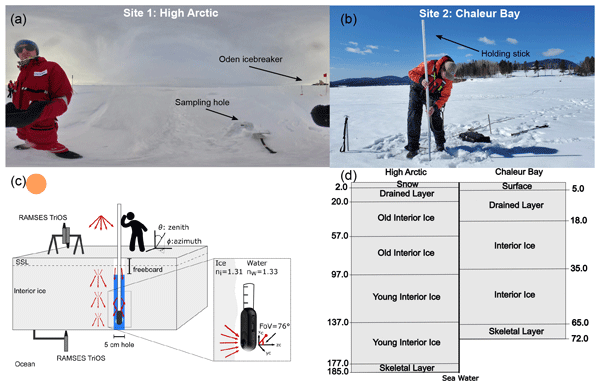
We developed a new method to study how light interacts with sea ice using a compact 360° camera. By lowering this camera into drilled holes in ice, we captured detailed light patterns inside different ice layers. Our research revealed how light is absorbed and scattered in both Arctic multi-year ice and thinner, seasonal ice in Quebec. These findings improve our understanding of sea ice structure and its role in the climate system, helping in the representation of sea ice in models.
Evgenii Salganik, Benjamin A. Lange, Christian Katlein, Ilkka Matero, Philipp Anhaus, Morven Muilwijk, Knut V. Høyland, and Mats A. Granskog
The Cryosphere, 17, 4873–4887, https://doi.org/10.5194/tc-17-4873-2023, https://doi.org/10.5194/tc-17-4873-2023, 2023
Short summary
Short summary
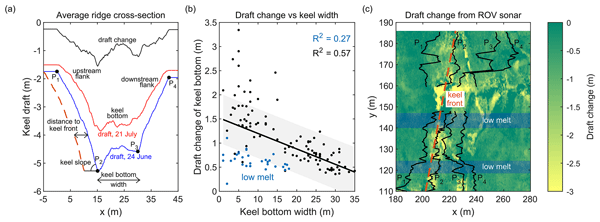
The Arctic Ocean is covered by a layer of sea ice that can break up, forming ice ridges. Here we measure ice thickness using an underwater sonar and compare ice thickness reduction for different ice types. We also study how the shape of ridged ice influences how it melts, showing that deeper, steeper, and narrower ridged ice melts the fastest. We show that deformed ice melts 3.8 times faster than undeformed ice at the bottom ice--ocean boundary, while at the surface they melt at a similar rate.
Marc de Vos, Panagiotis Kountouris, Lasse Rabenstein, John Shears, Mira Suhrhoff, and Christian Katlein
Hist. Geo Space. Sci., 14, 1–13, https://doi.org/10.5194/hgss-14-1-2023, https://doi.org/10.5194/hgss-14-1-2023, 2023
Short summary
Short summary
Poor visibility on the 3 d prior to the sinking of Sir Ernest Shackleton’s vessel, Endurance, during November 1915, hampered navigator Frank Worsley’s attempts to record its position. Thus, whilst the wreck was located in the Weddell Sea in March 2022, the drift path of Endurance during its final 3 d at the surface remained unknown. We used data from a modern meteorological model to reconstruct possible trajectories for this unknown portion of Endurance’s journey.
Christophe Perron, Christian Katlein, Simon Lambert-Girard, Edouard Leymarie, Louis-Philippe Guinard, Pierre Marquet, and Marcel Babin
The Cryosphere, 15, 4483–4500, https://doi.org/10.5194/tc-15-4483-2021, https://doi.org/10.5194/tc-15-4483-2021, 2021
Short summary
Short summary
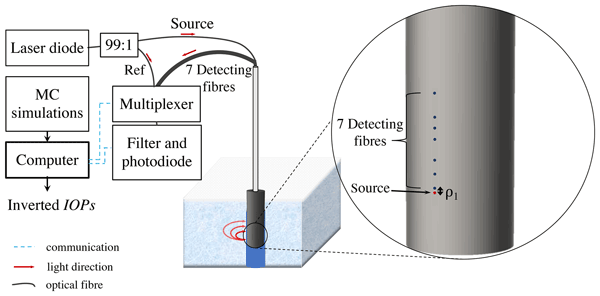
Characterizing the evolution of inherent optical properties (IOPs) of sea ice in situ is necessary to improve climate and arctic ecosystem models. Here we present the development of an optical probe, based on the spatially resolved diffuse reflectance method, to measure IOPs of a small volume of sea ice (dm3) in situ and non-destructively. For the first time, in situ vertically resolved profiles of the dominant IOP, the reduced scattering coefficient, were obtained for interior sea ice.
Thomas Krumpen, Luisa von Albedyll, Helge F. Goessling, Stefan Hendricks, Bennet Juhls, Gunnar Spreen, Sascha Willmes, H. Jakob Belter, Klaus Dethloff, Christian Haas, Lars Kaleschke, Christian Katlein, Xiangshan Tian-Kunze, Robert Ricker, Philip Rostosky, Janna Rückert, Suman Singha, and Julia Sokolova
The Cryosphere, 15, 3897–3920, https://doi.org/10.5194/tc-15-3897-2021, https://doi.org/10.5194/tc-15-3897-2021, 2021
Short summary
Short summary
We use satellite data records collected along the Multidisciplinary drifting Observatory for the Study of Arctic Climate (MOSAiC) drift to categorize ice conditions that shaped and characterized the floe and surroundings during the expedition. A comparison with previous years is made whenever possible. The aim of this analysis is to provide a basis and reference for subsequent research in the six main research areas of atmosphere, ocean, sea ice, biogeochemistry, remote sensing and ecology.
Christian Katlein, Lovro Valcic, Simon Lambert-Girard, and Mario Hoppmann
The Cryosphere, 15, 183–198, https://doi.org/10.5194/tc-15-183-2021, https://doi.org/10.5194/tc-15-183-2021, 2021
Short summary
Short summary
To improve autonomous investigations of sea ice optical properties, we designed a chain of multispectral light sensors, providing autonomous in-ice light measurements. Here we describe the system and the data acquired from a first prototype deployment. We show that sideward-looking planar irradiance sensors basically measure scalar irradiance and demonstrate the use of this sensor chain to derive light transmittance and inherent optical properties of sea ice.
Raphaël Larouche, Bastian Raulier, Christian Katlein, Simon Lambert-Girard, Simon Thibault, and Marcel Babin
The Cryosphere, 19, 4785–4804, https://doi.org/10.5194/tc-19-4785-2025, https://doi.org/10.5194/tc-19-4785-2025, 2025
Short summary
Short summary
We developed a new method to study how light interacts with sea ice using a compact 360° camera. By lowering this camera into drilled holes in ice, we captured detailed light patterns inside different ice layers. Our research revealed how light is absorbed and scattered in both Arctic multi-year ice and thinner, seasonal ice in Quebec. These findings improve our understanding of sea ice structure and its role in the climate system, helping in the representation of sea ice in models.
Evgenii Salganik, Benjamin A. Lange, Christian Katlein, Ilkka Matero, Philipp Anhaus, Morven Muilwijk, Knut V. Høyland, and Mats A. Granskog
The Cryosphere, 17, 4873–4887, https://doi.org/10.5194/tc-17-4873-2023, https://doi.org/10.5194/tc-17-4873-2023, 2023
Short summary
Short summary
The Arctic Ocean is covered by a layer of sea ice that can break up, forming ice ridges. Here we measure ice thickness using an underwater sonar and compare ice thickness reduction for different ice types. We also study how the shape of ridged ice influences how it melts, showing that deeper, steeper, and narrower ridged ice melts the fastest. We show that deformed ice melts 3.8 times faster than undeformed ice at the bottom ice--ocean boundary, while at the surface they melt at a similar rate.
Marc de Vos, Panagiotis Kountouris, Lasse Rabenstein, John Shears, Mira Suhrhoff, and Christian Katlein
Hist. Geo Space. Sci., 14, 1–13, https://doi.org/10.5194/hgss-14-1-2023, https://doi.org/10.5194/hgss-14-1-2023, 2023
Short summary
Short summary
Poor visibility on the 3 d prior to the sinking of Sir Ernest Shackleton’s vessel, Endurance, during November 1915, hampered navigator Frank Worsley’s attempts to record its position. Thus, whilst the wreck was located in the Weddell Sea in March 2022, the drift path of Endurance during its final 3 d at the surface remained unknown. We used data from a modern meteorological model to reconstruct possible trajectories for this unknown portion of Endurance’s journey.
Christophe Perron, Christian Katlein, Simon Lambert-Girard, Edouard Leymarie, Louis-Philippe Guinard, Pierre Marquet, and Marcel Babin
The Cryosphere, 15, 4483–4500, https://doi.org/10.5194/tc-15-4483-2021, https://doi.org/10.5194/tc-15-4483-2021, 2021
Short summary
Short summary
Characterizing the evolution of inherent optical properties (IOPs) of sea ice in situ is necessary to improve climate and arctic ecosystem models. Here we present the development of an optical probe, based on the spatially resolved diffuse reflectance method, to measure IOPs of a small volume of sea ice (dm3) in situ and non-destructively. For the first time, in situ vertically resolved profiles of the dominant IOP, the reduced scattering coefficient, were obtained for interior sea ice.
Thomas Krumpen, Luisa von Albedyll, Helge F. Goessling, Stefan Hendricks, Bennet Juhls, Gunnar Spreen, Sascha Willmes, H. Jakob Belter, Klaus Dethloff, Christian Haas, Lars Kaleschke, Christian Katlein, Xiangshan Tian-Kunze, Robert Ricker, Philip Rostosky, Janna Rückert, Suman Singha, and Julia Sokolova
The Cryosphere, 15, 3897–3920, https://doi.org/10.5194/tc-15-3897-2021, https://doi.org/10.5194/tc-15-3897-2021, 2021
Short summary
Short summary
We use satellite data records collected along the Multidisciplinary drifting Observatory for the Study of Arctic Climate (MOSAiC) drift to categorize ice conditions that shaped and characterized the floe and surroundings during the expedition. A comparison with previous years is made whenever possible. The aim of this analysis is to provide a basis and reference for subsequent research in the six main research areas of atmosphere, ocean, sea ice, biogeochemistry, remote sensing and ecology.
Christian Katlein, Lovro Valcic, Simon Lambert-Girard, and Mario Hoppmann
The Cryosphere, 15, 183–198, https://doi.org/10.5194/tc-15-183-2021, https://doi.org/10.5194/tc-15-183-2021, 2021
Short summary
Short summary
To improve autonomous investigations of sea ice optical properties, we designed a chain of multispectral light sensors, providing autonomous in-ice light measurements. Here we describe the system and the data acquired from a first prototype deployment. We show that sideward-looking planar irradiance sensors basically measure scalar irradiance and demonstrate the use of this sensor chain to derive light transmittance and inherent optical properties of sea ice.
Cited articles
Campbell, K., Matero, I., Bellas, C., Turpin-Jelfs, T., Anhaus, P., Graeve, M., Fripiat, F., Tranter, M., Landy, J. C., Sanchez-Baracaldo, P., Leu, E., Katlein, C., Mundy, C. J., Rysgaard, S., Tedesco, L., Haas, C., and Nicolaus, M.: Monitoring a changing Arctic: Recent advancements in the study of sea ice microbial communities, Ambio, 51, 318–332, https://doi.org/10.1007/s13280-021-01658-z, 2022.
Carlson, D. F., Pasma, J., Jacobsen, M. E., Hansen, M. H., Thomsen, S., Lillethorup, J. P., Tirsgaard, F. S., Flytkjær, A., Melvad, C., Laufer, K., Lund-Hansen, L. C., Meire, L., and Rysgaard, S.: Retrieval of Ice Samples Using the Ice Drone, Frontiers in Earth Science, 7, https://doi.org/10.3389/feart.2019.00287, 2019.
Faria, S. H., Weikusat, I., and Azuma, N.: The microstructure of polar ice. Part I: Highlights from ice core research, Journal of Structural Geology, 61, 2–20, https://doi.org/10.1016/j.jsg.2013.09.010, 2014.
Hildebrandt, M., Albiez, J., and Kirchner, F.: Computer-based control of deep-sea manipulators, OCEANS 2008-MTS/IEEE Kobe Techno-Ocean, 1–6, https://doi.org/10.1109/OCEANSKOBE.2008.4531026, 2008.
Katlein, C.: Towards ice core sampling by subsea robotic vehicles: Electronic supplement – Video from Coring Trials, Zenodo [video], https://doi.org/10.5281/zenodo.13221220, 2024.
Katlein, C., Schiller, M., Belter, H. J., Coppolaro, V., Wenslandt, D., and Nicolaus, M.: A New Remotely Operated Sensor Platform for Interdisciplinary Observations under Sea Ice, Frontiers in Marine Science, 4, https://doi.org/10.3389/fmars.2017.00281, 2017.
Lv, X., Cui, Z., Wang, T., Wen, Y., Liu, A., and Wang, R.: Research into mechanical modeling based on characteristics of the fracture mechanics of ice cutting for scientific drilling in polar regions, The Cryosphere, 18, 3351–3362, https://doi.org/10.5194/tc-18-3351-2024, 2024.
Maleki-Ghahfarokhi, A., Dianat, I., Azghani, M.-r., Asghari-Jafarabadi, M., and Parnianpour, M.: T-shaped handle set-up: effects of handle diameter, between-handle distance, workpiece orientation, working height, and exertion direction on two-handed torque strength, usability, comfort, and discomfort, Ergonomics, 66, 1015–1030, https://doi.org/10.1080/00140139.2022.2122587, 2023.
McFarland, C., Jakuba, M., Suman, S., Kinsey, J., and Whitcomb, L. L.: Toward Ice-Relative Navigation of Underwater Robotic Vehicles Under Moving Sea-Ice: Experimental Evaluation in the Arctic Sea IEEE ICRA 2015, Seattle WA, https://doi.org/10.1109/ICRA.2015.7139392, 2015.
Moore, J. C., Reid, A. P., and Kipfstuhl, J.: Microstructure and electrical properties of marine ice and its relationship to meteoric ice and sea ice, Journal of Geophysical Research: Oceans, 99, 5171–5180, https://doi.org/10.1029/93JC02832, 1994.
Rand, J. and Mellor, M.: Ice-coring augers for shallow depth sampling, https://apps.dtic.mil/sti/pdfs/ADA166630.pdf (last access: 18 October 2025), 1985.
Sivčev, S., Coleman, J., Omerdić, E., Dooly, G., and Toal, D.: Underwater manipulators: A review, Ocean Engineering, 163, 431–450, https://doi.org/10.1016/j.oceaneng.2018.06.018, 2018a.
Sivčev, S., Rossi, M., Coleman, J., Dooly, G., Omerdić, E., and Toal, D.: Fully automatic visual servoing control for work-class marine intervention ROVs, Control Engineering Practice, 74, 153–167, https://doi.org/10.1016/j.conengprac.2018.03.005, 2018b.
Talalay, P. G.: Mechanical ice drilling technology, Springer, https://doi.org/10.1007/978-981-10-0560-2, 2016.
Talalay, P. G. and Hong, J.: Perspectives for development of ice drilling technology: continuation of the discussion, Ann. Glaciol., 62, 143–156, https://doi.org/10.1017/aog.2020.81, 2021.
Thomsen, S., Hansen, M. H., Lillethorup, J. P., Tirsgaard, F. S., Flytkjær, A., Melvad, C., Rysgaard, S., and Carlson, D. F.: An affordable and miniature ice coring drill for rapid acquisition of small iceberg samples, HardwareX, 7, e00101, https://doi.org/10.1016/j.ohx.2020.e00101, 2020.
Timco, G. W. and Weeks, W. F.: A review of the engineering properties of sea ice, Cold Reg. Sci. Tech., 60, 107–129, https://doi.org/10.1016/j.coldregions.2009.10.003, 2010.
Vedachalam, N., Ramesh, S., Subramanian, A. N., Sathianarayanan, D., Ramesh, R., Harikrishnan, G., Pranesh, S. B., Prakash, V. D., Jyothi, V. B. N., Chowdhury, T., Ramadass, G. A., and Atmanand, M. A.: Design and development of Remotely Operated Vehicle for shallow waters and polar research, 2015 IEEE Underwater Technology (UT), 23–25 February 2015, 1–5, https://doi.org/10.1109/UT.2015.7108319, 2015.
Vedachalam, N., Vadivelan, A., Umapathy, A., Murugesan, M., Durai, G., Chandrasekaran, E., Jothi, C., Ramesh, R., Ramesh, S., and Ramadass, G. A.: Concept and testing of a remotely operated vehicle-mountable inductive electrothermal polar under-ice corer, Marine Technology Society Journal, 51, 33–43, 2017.
Welch, H. E., Bergmann, M. A., Jorgenson, J. K., and Burton, W.: A subice suction corer for sampling epontic ice algae, Canadian Journal of Fisheries and Aquatic Sciences, 45, 562–568, 1988.
Yang, Y. E. A.: ROV-mountable underwater thermal corer: General concept, The 8th International Ice Drill Symposium, Copenhagen, 30 September 2019, 2019.
Zacny, K., Mueller, J., Costa, T., Cwik, T., Gray, A., Zimmerman, W., Chow, P., Rehnmark, F., and Adams, G.: SLUSH: Europa hybrid deep drill, 2018 IEEE Aerospace Conference, 3–10 March 2018, 1–14, https://doi.org/10.1109/AERO.2018.8396596, 2018.
Zacny, K., Chu, P., Vendiola, V., Creekmore, P., Ng, P., Goldman, S., Seto, E., Bywaters, K., Bailey, E., Zheng, R., Ware, L., Rashedi, A., Beard, P., Chow, P., Dearing, S., Grossman, A., Huddleston, R., Humphrey, K., Jain, A., Lakomski, D., Mank, Z., Paulsen, G., Martinez, S., O'Bannon, T., Parekh, A., Shasho, J., Wang, A., Wilson, J., Xu, H., Quinn, J., Eichenbaum, A., Captain, J., and Kleinhenz, J.: TRIDENT Drill for VIPER and PRIME-1 Missions to the Moon, in: Earth and Space 2022, Proceedings, 465–474, https://doi.org/10.1061/9780784484470.043, 2023.
Short summary
In this paper we perform laboratory tests and investigate the feasibility to use existing subsea intervention technology, such as manipulator arms to retrieve short solid ice samples during under-ice dives of robotic vehicles. This investigation shows, that with minor modifications existing ice coring technology can be combined with existing subsea technology to provide novel sampling opportunities for submarine ice.
In this paper we perform laboratory tests and investigate the feasibility to use existing subsea...