
Articles | Volume 15, issue 1
https://doi.org/10.5194/gi-15-75-2026
© Author(s) 2026. This work is distributed under
the Creative Commons Attribution 4.0 License.
the Creative Commons Attribution 4.0 License.
https://doi.org/10.5194/gi-15-75-2026
© Author(s) 2026. This work is distributed under
the Creative Commons Attribution 4.0 License.
the Creative Commons Attribution 4.0 License.
Research article
| 
27 Feb 2026
Research article |
| 27 Feb 2026
| 27 Feb 2026
Design and implementation of a robust data logging and satellite telemetry system for remote cryospheric research
Sunil N. Oulkar
CORRESPONDING AUTHOR

School of Geography, University of Leeds, Leeds, United Kingdom
Matthew W. Peacey
Centre for Glaciology, Department of Geography and Earth Sciences, Aberystwyth University, Aberystwyth, United Kingdom
Michael Mitrev
Ground Control Technologies UK Ltd., Fareham, United Kingdom
Duncan J. Quincey
School of Geography, University of Leeds, Leeds, United Kingdom
Bryn Hubbard
Centre for Glaciology, Department of Geography and Earth Sciences, Aberystwyth University, Aberystwyth, United Kingdom
Tom Matthews
Department of Geography, King's College London, London, United Kingdom
Ankita S. Oulkar
Centre for Glaciology, Department of Geography and Earth Sciences, Aberystwyth University, Aberystwyth, United Kingdom
Katie E. Miles
Lancaster Environment Centre, Faculty of Science and Technology, Lancaster University, Lancaster, United Kingdom
Ann V. Rowan
Department of Earth Science, University of Bergen and Bjerknes Centre for Climate Research, Bergen, Norway
Related authors
No articles found.
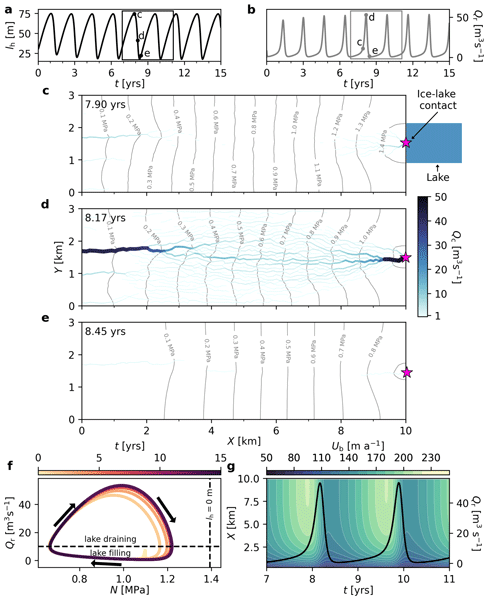
Adam J. Hepburn, Sammie Buzzard, Andrew J. Sole, Stephen J. Livingstone, Felix Ng, Mathieu Morlighem, Elizabeth A. Bagshaw, Caroline Clason, Lisa Craw, Christine F. Dow, Samuel Doyle, Jonathan Hawkins, Matthew Peacey, and Robert Storrar
The Cryosphere, 20, 5675–5696, https://doi.org/10.5194/tc-20-5675-2026, https://doi.org/10.5194/tc-20-5675-2026, 2026
Short summary
Short summary
Lakes at glacier margins can drain beneath the ice in devastating, floods called jökulhlaups. We present the first 2D model of jökulhlaup propagation, first applying it to a synthetic glacier, before then assessing its ability to reproduce an observed record of lake fill-drain cycles in Greenland. Our results match a 17-year record of flood timing but underpredicts peak discharge likely because we are missing certain physical processes. Our results hold promise for simulating jökulhlaups.
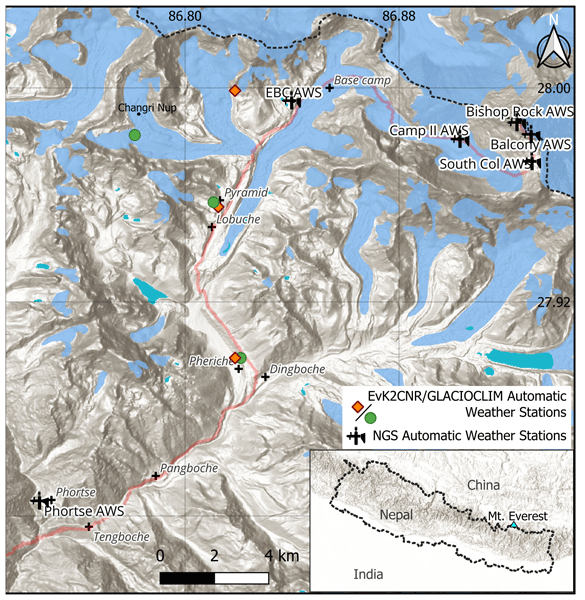
Arbindra Khadka, Lester Baker Perry, Tom Matthews, Tenzing Gyalzen Sherpa, Chitra Bahadur Shrestha, Dibas Shrestha, Deepak Aryal, Subash Tuladhar, Niraj Pradhananga, Dinkar Kayastha, Brian Raichle, Peter Athans, Dawa Yangzum Sherpa, Keith Garrett, Garrett Wheeler, Tom Young, and Aurora Elmore
Earth Syst. Sci. Data, 18, 7253–7267, https://doi.org/10.5194/essd-18-7253-2026, https://doi.org/10.5194/essd-18-7253-2026, 2026
Short summary
Short summary
We installed six automatic weather stations from 3,810 m to 8,810 m on Mount Everest region to better understand weather conditions at high altitudes. These measurements reveal how temperature, humidity, and wind changes with height and season. Our results show differences between observations and widely used ERA5 datasets. This improved knowledge helps scientists better understand mountain weather and climate, climate change and supports water resource planning for communities downstream.
Benjamin Graves, Tom Matthews, Tamsin Edwards, Richard Taylor, Megan James, Baker Perry, and Magali Ponds
EGUsphere, https://doi.org/10.5194/egusphere-2026-5187, https://doi.org/10.5194/egusphere-2026-5187, 2026
This preprint is open for discussion and under review for The Cryosphere (TC).
Short summary
Short summary
The future of the world’s glaciers under climate change is simulated using models. However, the modelled response of glaciers to rising temperatures is stronger in some models than in others. This study compares the simulated behaviour of a glacier at high elevation using four models to compare how each one reacts to rising temperatures. Simple models respond more strongly than is realistic, because they do not account for the full range of environmental factors which affect the glacier.
Tom Matthews, Baker Perry, Ben Graves, Fanny Brun, Maria Sanolaria-Otin, Navaraj Pokhrel, Arbindra Khadka, Dibas Shrestha, Ludving Cano, Aris Kwadijk, Walter Immereel, Brandt Maxwell, and Anton Seimon
EGUsphere, https://doi.org/10.5194/egusphere-2026-5200, https://doi.org/10.5194/egusphere-2026-5200, 2026
This preprint is open for discussion and under review for The Cryosphere (TC).
Short summary
Short summary
Extreme precipitation shapes hazards and water resources in high mountains, but is rarely observed directly. On 4 October 2025, weather stations on Mt. Everest recorded one of the most extreme snowfall events ever measured. The storm revealed that Himalayan snowfall extremes can be far larger than previously documented, and that intense snowfall can cool the atmosphere sufficiently to prevent rain at impact-sensitive elevations, complicating the picture of how warming will affect future storms.
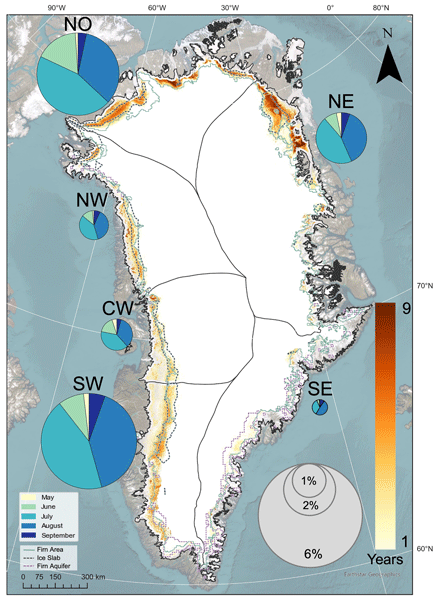
Emily Glen, Alison F. Banwell, Katie E. Miles, Amber A. Leeson, Rebecca L. Dell, Malcolm McMillan, and Jennifer Maddalena
The Cryosphere, 20, 4345–4365, https://doi.org/10.5194/tc-20-4345-2026, https://doi.org/10.5194/tc-20-4345-2026, 2026
Short summary
Short summary
Using satellite imagery and machine learning, we created the first Greenland-wide dataset of slush (waterlogged snow) from 2016 to 2024. Slush was widespread and varied strongly between years and across Greenland, becoming most extensive during high melt seasons. It was most common where melting was greater and snow had less capacity to store water. These findings show that slush should be included in models of future melting and sea-level rise.
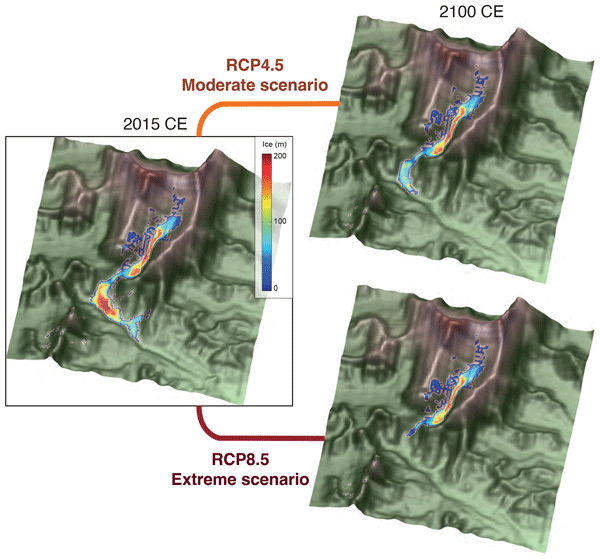
Anya M. Schlich-Davies, Ann V. Rowan, Andrew N. Ross, Duncan J. Quincey, and Vivi K. Pedersen
The Cryosphere, 20, 3151–3186, https://doi.org/10.5194/tc-20-3151-2026, https://doi.org/10.5194/tc-20-3151-2026, 2026
Short summary
Short summary
Glaciers in the Himalaya are shrinking in response to climate change. We use a glacier model to explore how future changes in precipitation distribution will drive the evolution of Khumbu Glacier in Nepal until 2100 CE. We find that, when compared to the impacts of climate warming alone, the combined effect of warming and the resulting increase in precipitation (rain and snowfall) could offset up to half of the glacier loss expected by the end of this Century.
Léa Rodari, Audrey Margirier, Ann V. Rowan, Christoph Schmidt, Remy Veness, Charlotte S. Curry, Alex C. Scoffield, Christiaan R. Diemont, Faye Perchanok, Guillaume Jouvet, Vivi Pedersen, Derek Fabel, and Georgina E. King
EGUsphere, https://doi.org/10.5194/egusphere-2026-1536, https://doi.org/10.5194/egusphere-2026-1536, 2026
Short summary
Short summary
By combining innovative dating techniques and glacier modelling, we studied how sediment is produced, transported, and stored within the Mer de Glace catchment in the French Alps. We show that whilst sediment is transported through the glacier in less than a millennium, some sediment can be stored for many thousands of years before being re-entrained into glacial transport. This long-term storage affects how landscapes evolve and how climate signals are preserved during deglaciation.
Megan C. James, Tamsin L. Edwards, Tom Matthews, Alexander T. Bradley, James F. O'Neill, and Harry Zekollari
EGUsphere, https://doi.org/10.5194/egusphere-2026-2069, https://doi.org/10.5194/egusphere-2026-2069, 2026
Short summary
Short summary
As the climate warms, glaciers are shrinking, contributing to sea-level rise, natural hazards and water insecurity. We show for one case study – the very long-term response of Iceland’s glaciers to global warming – that large uncertainties arise from the poorly known parameters within models. This is usually overlooked, but we show neglecting it underestimates uncertainty in our glacier model by as much as 90 %, highlighting the importance of accounting for it in future glacier projections.
Navaraj Pokhrel, Patrick Wagnon, Fanny Brun, Arbindra Khadka, Tom Matthews, Audrey Goutard, Dibas Shrestha, Baker Perry, and Marion Réveillet
The Cryosphere, 18, 5913–5920, https://doi.org/10.5194/tc-18-5913-2024, https://doi.org/10.5194/tc-18-5913-2024, 2024
Short summary
Short summary
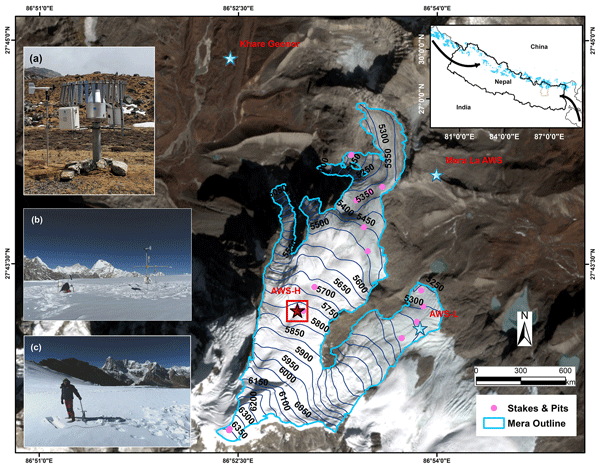
We studied snow processes in the accumulation area of Mera Glacier (central Himalaya, Nepal) by deploying a cosmic ray counting sensor that allows one to track the evolution of snow water equivalent. We suspect significant surface melting, water percolation, and refreezing within the snowpack, which might be missed by traditional mass balance surveys.
Maximillian Van Wyk de Vries, Tom Matthews, L. Baker Perry, Nirakar Thapa, and Rob Wilby
Geosci. Model Dev., 17, 7629–7643, https://doi.org/10.5194/gmd-17-7629-2024, https://doi.org/10.5194/gmd-17-7629-2024, 2024
Short summary
Short summary
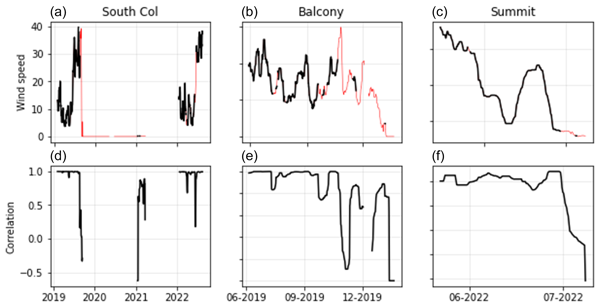
This paper introduces the AtsMOS workflow, a new tool for improving weather forecasts in mountainous areas. By combining advanced statistical techniques with local weather data, AtsMOS can provide more accurate predictions of weather conditions. Using data from Mount Everest as an example, AtsMOS has shown promise in better forecasting hazardous weather conditions, making it a valuable tool for communities in mountainous regions and beyond.
Anna Wendleder, Jasmin Bramboeck, Jamie Izzard, Thilo Erbertseder, Pablo d'Angelo, Andreas Schmitt, Duncan J. Quincey, Christoph Mayer, and Matthias H. Braun
The Cryosphere, 18, 1085–1103, https://doi.org/10.5194/tc-18-1085-2024, https://doi.org/10.5194/tc-18-1085-2024, 2024
Short summary
Short summary
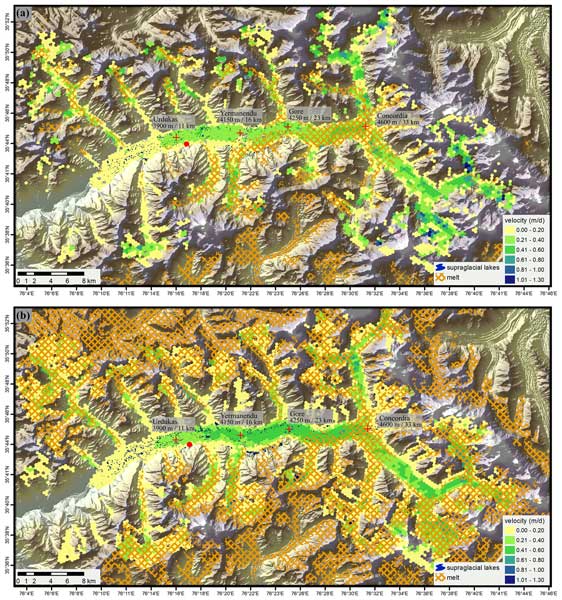
This study analyses the basal sliding and the hydrological drainage of Baltoro Glacier, Pakistan. The surface velocity was characterized by a spring speed-up, summer peak, and autumn speed-up. Snow melt has the largest impact on the spring speed-up, summer velocity peak, and the transition from inefficient to efficient drainage. Drainage from supraglacial lakes contributed to the fall speed-up. Increased summer temperatures will intensify the magnitude of meltwater and thus surface velocities.
Anja Løkkegaard, Kenneth D. Mankoff, Christian Zdanowicz, Gary D. Clow, Martin P. Lüthi, Samuel H. Doyle, Henrik H. Thomsen, David Fisher, Joel Harper, Andy Aschwanden, Bo M. Vinther, Dorthe Dahl-Jensen, Harry Zekollari, Toby Meierbachtol, Ian McDowell, Neil Humphrey, Anne Solgaard, Nanna B. Karlsson, Shfaqat A. Khan, Benjamin Hills, Robert Law, Bryn Hubbard, Poul Christoffersen, Mylène Jacquemart, Julien Seguinot, Robert S. Fausto, and William T. Colgan
The Cryosphere, 17, 3829–3845, https://doi.org/10.5194/tc-17-3829-2023, https://doi.org/10.5194/tc-17-3829-2023, 2023
Short summary
Short summary
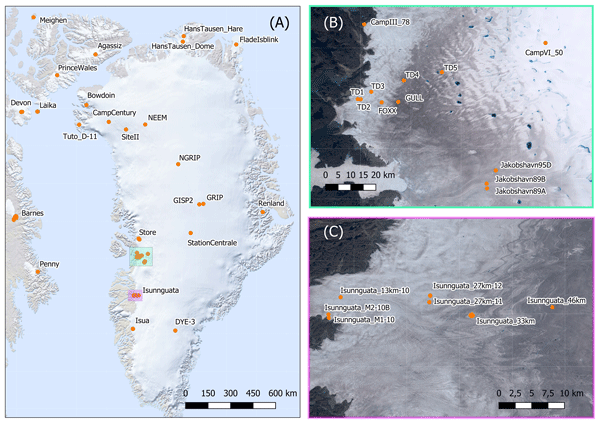
This study presents a database compiling 95 ice temperature profiles from the Greenland ice sheet and peripheral ice caps. Ice viscosity and hence ice flow are highly sensitive to ice temperature. To highlight the value of the database in evaluating ice flow simulations, profiles from the Greenland ice sheet are compared to a modeled temperature field. Reoccurring discrepancies between modeled and observed temperatures provide insight on the difficulties faced when simulating ice temperatures.
Guanyu Li, Mingyang Lv, Duncan J. Quincey, Liam S. Taylor, Xinwu Li, Shiyong Yan, Yidan Sun, and Huadong Guo
The Cryosphere, 17, 2891–2907, https://doi.org/10.5194/tc-17-2891-2023, https://doi.org/10.5194/tc-17-2891-2023, 2023
Short summary
Short summary
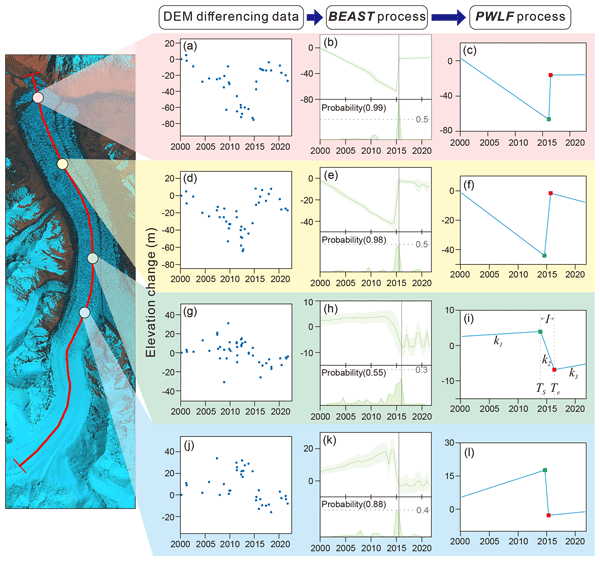
Kyagar Glacier in the Karakoram is well known for its surge history and its frequent blocking of the downstream valley, leading to a series of high-magnitude glacial lake outburst floods. Using it as a test bed, we develop a new approach for quantifying surge behaviour using successive digital elevation models. This method could be applied to other surge studies. Combined with the results from optical satellite images, we also reconstruct the surge process in unprecedented detail.
Liam S. Taylor, Duncan J. Quincey, and Mark W. Smith
Nat. Hazards Earth Syst. Sci., 23, 329–341, https://doi.org/10.5194/nhess-23-329-2023, https://doi.org/10.5194/nhess-23-329-2023, 2023
Short summary
Short summary
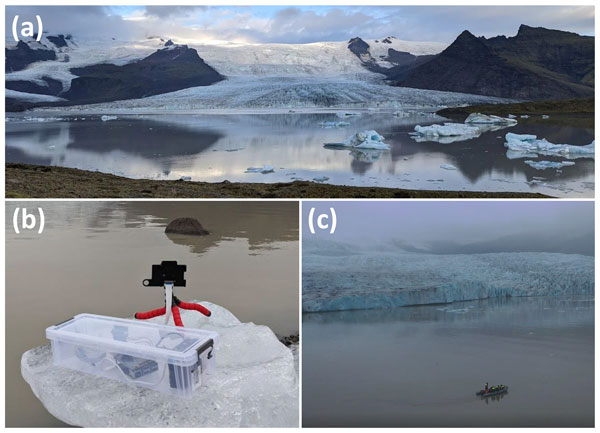
Hazards from glaciers are becoming more likely as the climate warms, which poses a threat to communities living beneath them. We have developed a new camera system which can capture regular, high-quality 3D models to monitor small changes in glaciers which could be indicative of a future hazard. This system is far cheaper than more typical camera sensors yet produces very similar quality data. We suggest that deploying these cameras near glaciers could assist in warning communities of hazards.
Christopher D. Stringer, Jonathan L. Carrivick, Duncan J. Quincey, and Daniel Nývlt
Earth Syst. Sci. Data Discuss., https://doi.org/10.5194/essd-2022-250, https://doi.org/10.5194/essd-2022-250, 2022
Revised manuscript not accepted
Short summary
Short summary
Glaciers in Antarctica have been decreasing in size at a fast rate, leading to the expansion of proglacial areas, with wide-ranging ecological implications. Several global land-cover maps exist, but they do not include Antarctica. We map land cover types across West Antarctica and the McMurdo Dry Valleys to a high degree of accuracy (77.0 %). We highlight the spatial variation in land cover and emphasise the need for more field data.
Gregoire Guillet, Owen King, Mingyang Lv, Sajid Ghuffar, Douglas Benn, Duncan Quincey, and Tobias Bolch
The Cryosphere, 16, 603–623, https://doi.org/10.5194/tc-16-603-2022, https://doi.org/10.5194/tc-16-603-2022, 2022
Short summary
Short summary
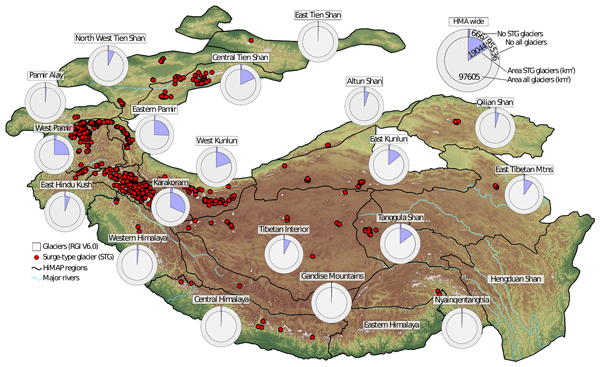
Surging glaciers show cyclical changes in flow behavior – between slow and fast flow – and can have drastic impacts on settlements in their vicinity.
One of the clusters of surging glaciers worldwide is High Mountain Asia (HMA).
We present an inventory of surging glaciers in HMA, identified from satellite imagery. We show that the number of surging glaciers was underestimated and that they represent 20 % of the area covered by glaciers in HMA, before discussing new physics for glacier surges.
Cited articles
Chan, K., Schillereff, D. N., Baas, A. C. W., Chadwick, M. A., Main, B., Mulligan, M., O'ssShea, F. T., Pearce, R., Smith, T. E. L., van Soesbergen, A., Tebbs, E., and Thompson, J.: Low-cost electronic sensors for environmental research: Pitfalls and opportunities, Progress in Physical Geography, 45, 305–338, https://doi.org/10.1177/0309133320956567, 2021.
Citterio, M., Van As, D., Ahlstrøm, A. P., Andersen, M. L., Andersen, S. B., Box, J. E., Charalampidis, C., Colgan, W. T., Fausto, R. S., Nielsen, S., and Veicherts, M.: Automatic weather stations for basic and applied glaciological research, GEUS Bulletin, 33, 69–72, https://doi.org/10.34194/GEUSB.V33.4512, 2015.
Costanza, C. A., Lazzara, M. A., Keller, L. M., and Cassano, J. J.: The surface climatology of the Ross Ice Shelf Antarctica, International Journal of Climatology, 36, 4929–4941, https://doi.org/10.1002/JOC.4681, 2016.
Doyle, S. H., Hubbard, B., Christoffersen, P., Young, T. J., Hofstede, C., Bougamont, M., Box, J. E., and Hubbard, A.: Physical Conditions of Fast Glacier Flow: 1. Measurements From Boreholes Drilled to the Bed of Store Glacier, West Greenland, Journal of Geophysical Research: Earth Surface, 123, 324–348, https://doi.org/10.1002/2017JF004529, 2018.
Fountain, A. G., Campbell, J. L., Schuur, E. A. G., Stammerjohn, S. E., Williams, M. W., and Ducklow, H. W.: The Disappearing Cryosphere: Impacts and Ecosystem Responses to Rapid Cryosphere Loss, BioScience, 62, 405–415, https://doi.org/10.1525/BIO.2012.62.4.11, 2012.
Garbo, A. and Mueller, D.: Cryologger Ice Tracking Beacon: A Low-Cost, Open-Source Platform for Tracking Icebergs and Ice Islands, Sensors 2024, 24, 1044, https://doi.org/10.3390/S24041044, 2024.
Gardner, A. S., Schlegel, N.-J., and Larour, E.: Glacier Energy and Mass Balance (GEMB): a model of firn processes for cryosphere research, Geosci. Model Dev., 16, 2277–2302, https://doi.org/10.5194/gmd-16-2277-2023, 2023.
Ground Control: https://docs.groundcontrol.com/iot/rockremote-mini (last access: 6 February 2026), 2026a.
Ground Control: https://docs.groundcontrol.com/iot/rockremote-mini/overview/serial-interface (last access: 6 February 2026), 2026b.
Hay, J. E. and Fitzharris, B. B.: A Comparison of the Energy-Balance and Bulk-aerodynamic Approaches for Estimating Glacier Melt, Journal of Glaciology, 34, 145–153, https://doi.org/10.3189/S0022143000032172, 1988.
Heucke, E.: A Light Portable Steam-driven Ice Drill Suitable for Drilling Holes in Ice and Firn, Geografiska Annaler: Series A, Physical Geography, 81, 603–609, https://onlinelibrary.wiley.com/doi/epdf/10.1111/1468-0459.00088 (last access: 6 February 2026), 1999.
Hieronymus, M. and Kalén, O.: Sea-level rise projections for Sweden based on the new IPCC special report: The ocean and cryosphere in a changing climate, Ambio, 49, 1587–1600, https://doi.org/10.1007/s13280-019-01313-8, 2020.
Hugonnet, R., McNabb, R., Berthier, E., Menounos, B., Nuth, C., Girod, L., Farinotti, D., Huss, M., Dussaillant, I., Brun, F., and Kääb, A.: Accelerated global glacier mass loss in the early twenty-first century, Nature, 592, 726–731, https://doi.org/10.1038/s41586-021-03436-z, 2021.
Immerzeel, W. W., Petersen, L., Ragettli, S., and Pellicciotti, F.: The importance of observed gradients of air temperature and precipitation for modeling runoff from a glacierized watershed in the Nepalese Himalayas, Water Resour. Res., 50, https://doi.org/10.1002/2013WR014506, 2014.
Kulkarni, A. V., Shirsat, T. S., Kulkarni, A., Negi, H. S., Bahuguna, I. M., and Thamban, M.: State of Himalayan cryosphere and implications for water security, Water Security, 14, 100101, https://doi.org/10.1016/J.WASEC.2021.100101, 2021.
Li, S., Yao, T., Yang, W., Yu, W., and Zhu, M.: Glacier Energy and Mass Balance in the Inland Tibetan Plateau: Seasonal and Interannual Variability in Relation to Atmospheric Changes, Journal of Geophysical Research: Atmospheres, 123, 6390–6409, https://doi.org/10.1029/2017JD028120, 2018.
Martin, R., Muûls, M., De Preux, L. B., Wagner, U. J., De Bousies, F., De Vlieger, P., Disch, D., Domokos, E., Elsasser, L., Franzen, H., Kervyn, M., Kopetka, Z., Kurtyka, O., Laurain, A.-L., Lujan, E., Polsterer, N., Martin-Regniault, A., Snoy, M., Romanowicz, J., and Van Reenen, J.: Industry Compensation under Relocation Risk: A Firm-Level Analysis of the EU Emissions Trading Scheme, American Economic Review, 104, 2482–2508, https://doi.org/10.1257/AER.104.8.2482, 2014.
Martinez, K. and Hart, J. K.: Glacier Monitoring: Deploying Custom Hardware in Harsh Environments, Wireless Sensor Networks: Deployments and Design Frameworks, 245–258, https://doi.org/10.1007/978-1-4419-5834-1_9, 2010.
Matthews, T., Perry, L. B., Koch, I., Aryal, D., Khadka, A., Shrestha, D., Abernathy, K., Elmore, A. C., Seimon, A., Tait, A., Elvin, S., Tuladhar, S., Baidya, S. K., Potocki, M., Birkel, S. D., Kang, S., Sherpa, T. C., Gajurel, A., and Mayewski, P. A.: Going to extremes: Installing the world's highest weather stations on mount everest, Bulletin of the American Meteorological Society, 2020, https://doi.org/10.1175/BAMS-D-19-0198.1, 2020a.
Matthews, T., Perry, L. B., Lane, T. P., Elmore, A. C., Khadka, A., Aryal, D., Shrestha, D., Tuladhar, S., Baidya, S. K., Gajurel, A., Potocki, M., and Mayewski, P. A.: Into Thick(er) Air? Oxygen Availability at Humans' Physiological Frontier on Mount Everest, IScience, 23, https://doi.org/10.1016/j.isci.2020.101718, 2020b.
Matthews, T., Perry, B., Khadka, A., Sherpa, T. G., Shrestha, D., Aryal, D., Tuldahar, S., Thapa, N., Pradhananga, N., Athans, P., Sherpa, D. Y., Guy, H., Seimon, A., Elmore, A., Li, K., and Alexiev, N.: Weather Observations Reach the Summit of Mount Everest, Bulletin of the American Meteorological Society, 103, E2827–E2835, https://doi.org/10.1175/BAMS-D-22-0120.1, 2022.
Maurer, J. M., Schaefer, J. M., Russell, J. B., Rupper, S., Wangdi, N., Putnam, A. E., and Young, N.: Seismic observations, numerical modeling, and geomorphic analysis of a glacier lake outburst flood in the Himalayas, Science Advances, 6, 3645–3661, https://doi.org/10.1126/sciadv.aba3645, 2020.
Miles, K. E., Hubbard, B., Quincey, D. J., Miles, E. S., Sherpa, T. C., Rowan, A. V., and Doyle, S. H.: Polythermal structure of a Himalayan debris-covered glacier revealed by borehole thermometry, Scientific Reports, 8, https://doi.org/10.1038/s41598-018-34327-5, 2018.
Nazir, S., Fairhurst, G., and Verdicchio, F.: WiSE – a satellite-based system for remote monitoring, International Journal of Satellite Communications and Networking, 35, 201–214, https://doi.org/10.1002/sat.1176, 2017.
Oulkar, S. N., Sharma, P., Laha, S., Pratap, B., and Thamban, M.: Temporal variability in air temperature lapse rates across the glacierised terrain of the Chandra basin, western Himalaya, Theoretical and Applied Climatology, 155, 6069–6083, https://doi.org/10.1007/s00704-024-05003-8, 2024.
Oulkar, S. N., Peacey, M. W., Mitrev, M., Quincey, D. J., Hubbard, B., Matthews, T., Oulkar, A. S., Miles, K. E., and Rowan, A. V.: DrSNO-Sunil/LtC: v1.0.0 (v1.0.0), Zenodo [data set], https://doi.org/10.5281/zenodo.16985625, 2025.
Pernov, J. B., Gros-Daillon, J., and Schmale, J.: Comparison of selected surface level ERA5 variables against in-situ observations in the continental Arctic, Quarterly Journal of the Royal Meteorological Society, 150, 2123–2146, https://doi.org/10.1002/QJ.4700, 2024.
RGI 7.0: Randolph Glacier Inventory – A Dataset of Global Glacier Outlines, Version 7.0, Boulder, Colorado USA, NSIDC: National Snow and Ice Data Center [data set], https://doi.org/10.5067/f6jmovy5navz, 2023.
Rückamp, M., Cheng, G., Gutjahr, K., Möller, M., Pellikka, P. K. E., and Mayer, C.: Future Retreat of Great Aletsch Glacier and Hintereisferner – application of a full-Stokes model to two valley glaciers in the European Alps, EGUsphere [preprint], https://doi.org/10.5194/egusphere-2025-3150, 2025.
Sicart, J. E., Litt, M., Helgason, W., Tahar, V. B., and Chaperon, T.: A study of the atmospheric surface layer and roughness lengths on the high-altitude tropical Zongo glacier, Bolivia, Journal of Geophysical Research, 119, 3793–3808, https://doi.org/10.1002/2013JD020615, 2014.
Sugiyama, S., Sakakibara, D., Tsutaki, S., Maruyama, M., and Sawagaki, T.: Glacier dynamics near the calving front of Bowdoin Glacier, northwestern Greenland, Journal of Glaciology, 61, 223–232, https://doi.org/10.3189/2015JOG14J127, 2015.
Tartari, G., Vuillermoz, E., Bonasoni, P., Manfredi, E., and Team, B. S.: High altitude environmental monitoring: the SHARE project and CEOP-HE, EGU General Assembly 2009, 19–24 April 2009, EGU2009-EGUGA, 11, 2340, https://ui.adsabs.harvard.edu/abs/2009EGUGA..11.2340T/abstract (last access: 17 February 2026), 2009.
Tetzlaff, D., Carey, S. K., McNamara, J. P., Laudon, H., and Soulsby, C.: The essential value of long-term experimental data for hydrology and water management, Water Resources Research, 53, 2598–2604, https://doi.org/10.1002/2017WR020838, 2017.
Short summary
We designed and tested a system that can record and send data in near real time from extreme and remote locations, such as Mount Everest. Using solar power and satellite communication, the system worked reliably at high altitude, showing it can be applied in other remote regions. This approach will help scientists collect vital information on how the environment is changing in areas that are normally very difficult to study.
We designed and tested a system that can record and send data in near real time from extreme and...


