
Articles | Volume 15, issue 1
https://doi.org/10.5194/gi-15-183-2026
© Author(s) 2026. This work is distributed under
the Creative Commons Attribution 4.0 License.
the Creative Commons Attribution 4.0 License.
https://doi.org/10.5194/gi-15-183-2026
© Author(s) 2026. This work is distributed under
the Creative Commons Attribution 4.0 License.
the Creative Commons Attribution 4.0 License.
Research article
| 
21 May 2026
Research article |
| 21 May 2026
| 21 May 2026
Enhanced removal of very low frequency and low frequency radio noise from transient electromagnetic data with modeling and adaptive filtering
Michel Hardenberg
Department of Electrical and Computer Engineering, Aarhus University, Finlandsgade 22, 8200 Aarhus N, Denmark

Department of Electrical and Computer Engineering, Aarhus University, Finlandsgade 22, 8200 Aarhus N, Denmark
Related authors
Sikender Gul, Matthew Peter Griffiths, Michel Hardenberg, and Jakob Juul Larsen
EGUsphere, https://doi.org/10.5194/egusphere-2026-5657, https://doi.org/10.5194/egusphere-2026-5657, 2026
This preprint is open for discussion and under review for Geoscientific Instrumentation, Methods and Data Systems (GI).
Short summary
Short summary
One of the controlling factors for the depth-of-investigation in groundwater measurements with surface nuclear magnetic resonance (NMR) is the maximum current of the transmitter pulses. Increasing the maximum current of a surface NMR transmitter is generally a costly and difficult engineering challenge. However, the challenge can be partially circumvented by operating two (or more) transmitter units in unison. We demonstrate the approach with a field measurement at a well characterized site.
Sikender Gul, Matthew Peter Griffiths, Michel Hardenberg, and Jakob Juul Larsen
EGUsphere, https://doi.org/10.5194/egusphere-2026-5657, https://doi.org/10.5194/egusphere-2026-5657, 2026
This preprint is open for discussion and under review for Geoscientific Instrumentation, Methods and Data Systems (GI).
Short summary
Short summary
One of the controlling factors for the depth-of-investigation in groundwater measurements with surface nuclear magnetic resonance (NMR) is the maximum current of the transmitter pulses. Increasing the maximum current of a surface NMR transmitter is generally a costly and difficult engineering challenge. However, the challenge can be partially circumvented by operating two (or more) transmitter units in unison. We demonstrate the approach with a field measurement at a well characterized site.
Mathias Vang, Jakob Juul Larsen, Anders Vest Christiansen, and Denys Grombacher
Hydrol. Earth Syst. Sci., 29, 5315–5329, https://doi.org/10.5194/hess-29-5315-2025, https://doi.org/10.5194/hess-29-5315-2025, 2025
Short summary
Short summary
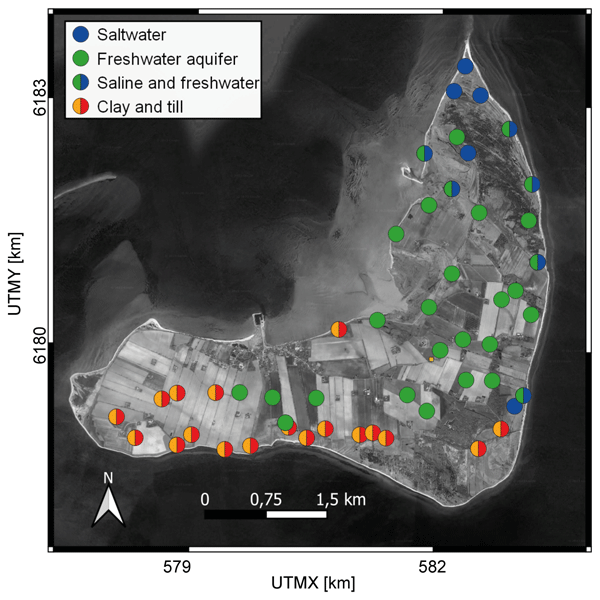
To manage groundwater effectively, it is important to understand subsurface water systems. Geophysical methods can characterize subsurface layers, but relying on just one method can be misleading. This study combines two methods – transient electromagnetics and surface nuclear magnetic resonance – in a K-means clustering scheme to better resolve freshwater and saltwater zones. Two case studies showed how a combined approach improves characterization of these hydrogeologically important layers.
Nikhil B. Gaikwad, Lichao Liu, Matthew P. Griffiths, Denys Grombacher, and Jakob Juul Larsen
Geosci. Instrum. Method. Data Syst., 14, 139–151, https://doi.org/10.5194/gi-14-139-2025, https://doi.org/10.5194/gi-14-139-2025, 2025
Short summary
Short summary
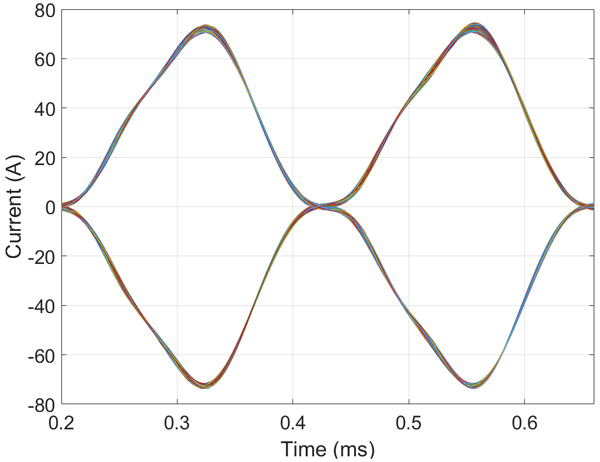
This work presents simulations, modelling, and experimental verification of a novel steady-state surface nuclear magnetic resonance (NMR) transmitter used for the non-invasive exploration of groundwater. The paper focuses on three main aspects of high-current transmitter instrumentation: thermal management, current-drooping, and pulse stability. This work will interest readers involved in geoscientific instrument prototyping for groundwater exploration using portable geoscientific instruments.
Smith Kashiram Khare, Paul McLachlan, Pradip Kumar Maurya, and Jakob Juul Larsen
Geosci. Instrum. Method. Data Syst., 13, 27–41, https://doi.org/10.5194/gi-13-27-2024, https://doi.org/10.5194/gi-13-27-2024, 2024
Short summary
Short summary
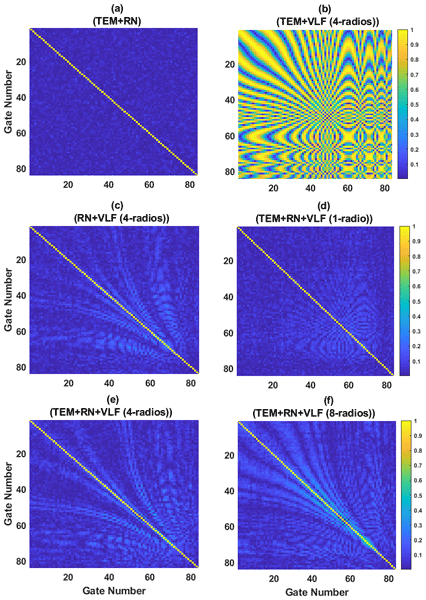
Data recorded with transient electromagnetics are typically gated to improve the signal-to-noise ratio. Gating corresponds to low-pass filtering of data with the shape of the gate giving the frequency response. We show that standard gate shapes can lead to significant correlation between gates caused by distortion from VLF radios. A multi-objective cost function is used to select optimum gate shapes with less influence from radio noise. Performance is demonstrated using synthetic and field data.
Mathias Vang, Denys Grombacher, Matthew P. Griffiths, Lichao Liu, and Jakob Juul Larsen
Hydrol. Earth Syst. Sci., 27, 3115–3124, https://doi.org/10.5194/hess-27-3115-2023, https://doi.org/10.5194/hess-27-3115-2023, 2023
Short summary
Short summary
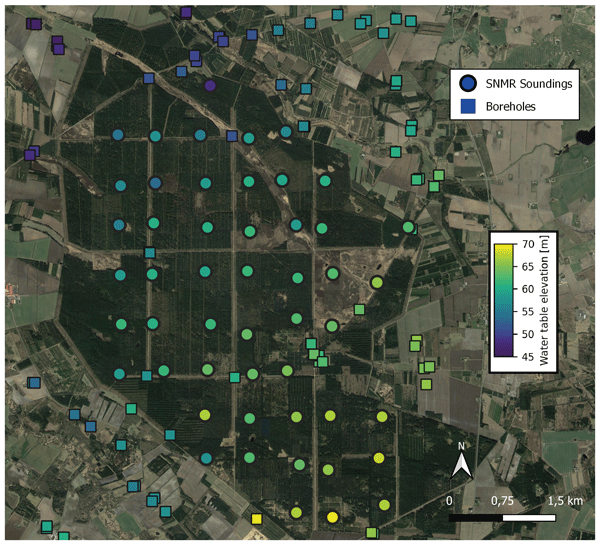
In this paper, we use a novel surface nuclear magnetic resonance (SNMR) method for rapid high-quality data acquisition. The SNMR results from more than 100 soundings in three different case studies were used to map groundwater. The soundings successfully track the water table through the three areas and are compared to boreholes and other geophysical measurements. The study highlights the use of SNMR in hydrological surveys and as a tool for regional mapping of the water table.
Muhammad Rizwan Asif, Nikolaj Foged, Thue Bording, Jakob Juul Larsen, and Anders Vest Christiansen
Earth Syst. Sci. Data, 15, 1389–1401, https://doi.org/10.5194/essd-15-1389-2023, https://doi.org/10.5194/essd-15-1389-2023, 2023
Short summary
Short summary
To apply a deep learning (DL) algorithm to electromagnetic (EM) methods, subsurface resistivity models and/or the corresponding EM responses are often required. To date, there are no standardized EM datasets, which hinders the progress and evolution of DL methods due to data inconsistency. Therefore, we present a large-scale physics-driven model database of geologically plausible and EM-resolvable subsurface models to incorporate consistency and reliability into DL applications for EM methods.

M. Andy Kass, Esben Auken, Jakob Juul Larsen, and Anders Vest Christiansen
Geosci. Instrum. Method. Data Syst., 10, 313–323, https://doi.org/10.5194/gi-10-313-2021, https://doi.org/10.5194/gi-10-313-2021, 2021
Short summary
Short summary
We have developed a towed magnetic gradiometer system for rapid acquisition of magnetic and magnetic gradient maps. This high-resolution system is flexible and has applications to utility detection, archaeology, unexploded ordnance, or any other applications where high-resolution maps of the magnetic field or gradient are required. Processing of the data has been simplified as much as possible to facilitate rapid results and interpretations.
Cited articles
Asif, M. R., Maurya, P. K., Foged, N., Larsen, J. J., Auken, E., and Christiansen, A. V.: Automated Transient Electromagnetic Data Processing for Ground-Based and Airborne Systems by a Deep Learning Expert System, IEEE T. Geosci. Remote, 60, 5919814, https://doi.org/10.1109/TGRS.2022.3202304, 2022. a
Auken, E., Foged, N., Larsen, J. J., Lassen, K. V. T., Maurya, P. K., Dath, S. M., and Eiskjær, T. T.: tTEM – A towed transient electromagnetic system for detailed 3D imaging of the top 70 m of the subsurface, Geophysics, 84, E13–E22, https://doi.org/10.1190/geo2018-0355.1, 2019. a
Behroozmand, A. A., Auken, E., and Knight, R.: Assessment of Managed Aquifer Recharge Sites Using a New Geophysical Imaging Method, Vadose Zone J., 18, 1–13, https://doi.org/10.2136/vzj2018.10.0184, 2019. a
Chandra, S., Auken, E., Maurya, P. K., Ahmed, S., and Verma, S. K.: Large Scale Mapping of Fractures and Groundwater Pathways in Crystalline Hardrock By AEM, Scientific Reports, 9, 398, https://doi.org/10.1038/s41598-018-36153-1, 2019. a
Chen, K., Zhang, J., Xue, G., Huang, H., Chen, W., Hao, J., and Yue, Y.: Feasibility of Monitoring Hydraulic Connections between Aquifers Using Time-lapse TEM: A Case History in Inner Mongolia, China, J. Environ. Eng. Geoph., 24, 361–372, https://doi.org/10.2113/JEEG24.3.361, 2019. a
Engebretsen, K. W., Zhang, B., Fiandaca, G., Madsen, L. M., Auken, E., and Christiansen, A. V.: Accelerated 2.5-D inversion of airborne transient electromagnetic data using reduced 3-D meshing, Geophys. J. Int., 230, 643–653, https://doi.org/10.1093/gji/ggac077, 2022. a
Eppelbaum, L. V.: VLF-method of geophysical prospecting: A non-conventional system of processing and interpretation (implementation in the Caucasian ore deposits), ANAS Transactions, Earth Sciences, 2, 16–38, https://doi.org/10.33677/ggianas20210200060, 2021. a
Farhang-Boroujeny, B.: Adaptive Filters – Theory and Applications, Wiley, 2nd edn., ISBN: 978-1-119-97954-8, 2013. a
Gisselø, P., Daoultzis, P., and Smart, E.: Deep Targeting With Airborne Electromagnetic Surveys, in: NSG2024, 4th Conference on Airborne, Drone and Robotic Geophysics, Helsinki, Finland, 8–12 September 2024, European Association of Geoscientists & Engineers (EAGE), 1–5, https://doi.org/10.3997/2214-4609.202420190, 2024. a
Hördt, A., Andrieux, P., Neubauer, F. M., Rüter, and Vozoff, K.: A first attempt at monitoring underground gas storage by means of time‐lapse multichannel transient electromagnetics, Geophys. Prospect., 48, 489–509, https://doi.org/10.1046/j.1365-2478.2000.00192.x, 2000. a
Khare, S. K., McLachlan, P., Maurya, P. K., and Larsen, J. J.: An optimized and hybrid gating scheme for the suppression of very low-frequency radios in transient electromagnetic systems, Geosci. Instrum. Method. Data Syst., 13, 27–41, https://doi.org/10.5194/gi-13-27-2024, 2024. a, b, c, d
Larsen, J. J.: VLF Modelling, Version v1, Zenodo [data set], https://doi.org/10.5281/zenodo.19051738, 2026. a
Larsen, J. J., Pedersen, S. S., Foged, N., and Auken, E.: Suppression of very low frequency radio noise in transient electromagnetic data with semi-tapered gates, Geosci. Instrum. Method. Data Syst., 10, 81–90, https://doi.org/10.5194/gi-10-81-2021, 2021. a, b, c, d
Lysdahl, A. K., Christensen, C. W., Pfaffhuber, A. A., Vöge, M., Andresen, L., Skurdal, G. H., and Panzner, M.: Integrated bedrock model combining airborne geophysics and sparse drillings based on an artificial neural network, Eng. Geol., 297, 106484, https://doi.org/10.1016/j.enggeo.2021.106484, 2022. a
Macnae, J.: Stripping very low frequency communication signals with minimum shift keying encoding from streamed time-domain electromagnetic data, Geophysics, 80, E343–E353, https://doi.org/10.1190/geo2015-0304.1, 2015. a, b, c
Macnae, J. C., Lamontagne, Y., and West, G. F.: Noise processing techniques for time‐domain EM systems, Geophysics, 49, 934–948, https://doi.org/10.1190/1.1441739, 1984. a
McLachlan, P., Christensen, N. B., Grombacher, D., and Christiansen, A. V.: Evaluating the impact of correlated noise for time‐lapse transient electromagnetic (TEM) monitoring studies, Near Surf. Geophys., 21, 333–342, https://doi.org/10.1002/nsg.12262, 2023. a, b
Morelli, M. and Vitetta, G.: Joint phase and timing synchronization algorithms for MSK-type signals, in: 1999 IEEE Communications Theory Mini-Conference (Cat. No.99EX352), Vancouver, BC, Canada, 6–10 June 1999, IEEE, 146–150, https://doi.org/10.1109/CTMC.1999.790254, 1999. a
Nabighian, M. N. and Macnae, J. C.: Chapter 6: Time Domain Electromagnetic Prospecting Methods, in: Electromagnetic Methods in Applied Geophysics: Volume 2, Application, Parts A and B, SEG Library, 427–520, https://doi.org/10.1190/1.9781560802686.ch6, 1991. a
Peng, C., Zhu, K., Fan, T., and Yang, Y.: Suppressing the very low-frequency noise by B-spline gating of transient electromagnetic data, J. Geophys. Eng., 19, 761–774, https://doi.org/10.1093/jge/gxac049, 2022. a
Qi, Z., Li, X., Li, H., and Liu, W.: First Results From Drone-Based Transient Electromagnetic Survey to Map and Detect Unexploded Ordnance, IEEE Geosci. Remote S., 17, 2055–2059, https://doi.org/10.1109/LGRS.2019.2962754, 2020. a
Swidinsky, A. and El-Kaliouby, H.: Time-lapse transient electromagnetic monitoring of a water infiltration experiment: An application to the Central Avra Valley recharge basin, Tucson, Arizona, in: SEG Technical Program Expanded Abstracts, 4439–4443, https://doi.org/10.1190/segam2013-0331.1, 2013. a
WikiPedia: DCF77, https://en.wikipedia.org/wiki/DCF77 (last access: 19 June 2025), 2025. a
With, C., Löfroth, H., Bastani, M., Persson, L., Rodhe, L., and Hedfors, J., and Schoning, K.: A methodology for mapping of quick clay in Sweden, Nat. Hazards, 112, 2549–2576, https://doi.org/10.1007/s11069-022-05278-y, 2022. a
Wu, S., Huang, Q., and Zhao, L.: A deep learning-based network for the simulation of airborne electromagnetic responses, Geophys. J. Int., 233, 253–263, https://doi.org/10.1093/gji/ggac463, 2022. a
Zamora-Luria, J. C., McLachlan, P., Maurya, P. K., Liu, L., Grombacher, D., and Christiansen, A. V.: A feasibility study on time-lapse transient electromagnetics for monitoring groundwater dynamics, Geophysics, 88, E135–E146, https://doi.org/10.1190/GEO2022-0532.1, 2023. a, b, c
Short summary
Transient electromagnetics (TEM) is traditionally used for mapping, but new use-cases are emerging. For example, a stationary TEM instrument can gather time-lapse data. By observing dynamic changes of the subsurface resistivity model, it is possible to track changes in groundwater levels. However, the changes are minuscule and data sets with very high signal-to-noise ratios are therefore crucial. We demonstrate a method for suppressing noise from a specific type of radio noise.
Transient electromagnetics (TEM) is traditionally used for mapping, but new use-cases are...


