Articles | Volume 7, issue 1
https://doi.org/10.5194/gi-7-55-2018
© Author(s) 2018. This work is distributed under
the Creative Commons Attribution 4.0 License.
https://doi.org/10.5194/gi-7-55-2018
© Author(s) 2018. This work is distributed under
the Creative Commons Attribution 4.0 License.
A remote-control datalogger for large-scale resistivity surveys and robust processing of its signals using a software lock-in approach
Frank Oppermann
CORRESPONDING AUTHOR
Leibniz Institute for Applied Geophysics, Hannover, 30655, Germany
Thomas Günther
Leibniz Institute for Applied Geophysics, Hannover, 30655, Germany
Related authors
Tobias Nickschick, Christina Flechsig, Jan Mrlina, Frank Oppermann, Felix Löbig, and Thomas Günther
Solid Earth, 10, 1951–1969, https://doi.org/10.5194/se-10-1951-2019, https://doi.org/10.5194/se-10-1951-2019, 2019
Short summary
Short summary
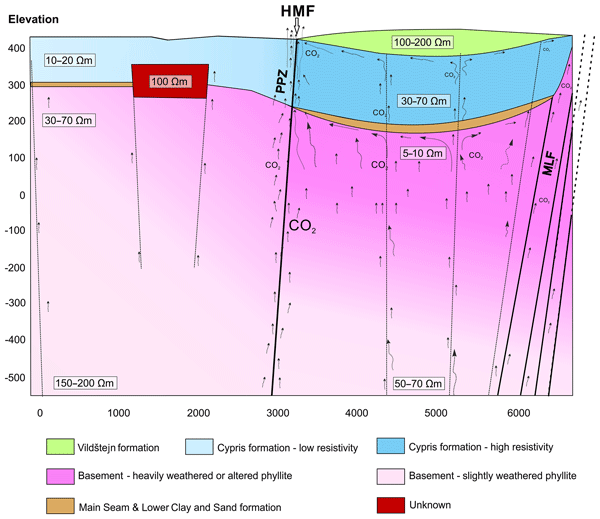
An active CO2 degassing site in the western Eger Rift, Czech Republic, was investigated with a 6.5 km long geophysical survey using a specific large-scale geoelectrical setup, supported by shallow geoelectrical surveys and gravity measurements. The experiment reveals unusually low resistivities in the sediments and basement below the degassing area of less than 10 Ω and provides a base for a custom geological model of the area for a future 400 m deep research drilling in this area.
Janek Greskowiak, Rena Meyer, Jairo Cueto, Nico Skibbe, Anja Reckhardt, Thomas Günther, Stephan Ludger Seibert, Kai Schwalfenberg, Dietmar Pommerin, Mike Müller-Petke, and Gudrun Massmann
EGUsphere, https://doi.org/10.5194/egusphere-2025-3132, https://doi.org/10.5194/egusphere-2025-3132, 2025
This preprint is open for discussion and under review for Hydrology and Earth System Sciences (HESS).
Short summary
Short summary
Mixing of fresh groundwater and circulating seawater below beaches triggers water-rock chemical reactions and may affect coastal water quality. The subsurface of so-called high-energy beaches that are exposed to high tides, waves and storm floods are understudied as monitoring under these conditions is difficult. For the first time, this study quantifies the subsurface flow and mixing processes of a high-energy beach with the help of computer simulations based on an extensive set of field data.
Sonja H. Wadas, Hermann Buness, Raphael Rochlitz, Peter Skiba, Thomas Günther, Michael Grinat, David C. Tanner, Ulrich Polom, Gerald Gabriel, and Charlotte M. Krawczyk
Solid Earth, 13, 1673–1696, https://doi.org/10.5194/se-13-1673-2022, https://doi.org/10.5194/se-13-1673-2022, 2022
Short summary
Short summary
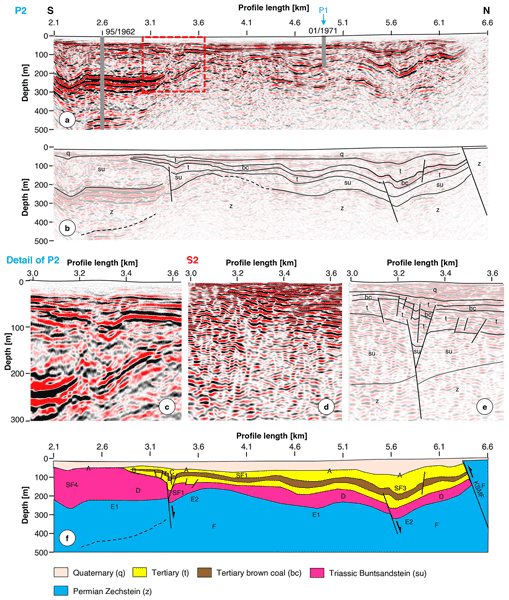
The dissolution of rocks poses a severe hazard because it can cause subsidence and sinkhole formation. Based on results from our study area in Thuringia, Germany, using P- and SH-wave reflection seismics, electrical resistivity and electromagnetic methods, and gravimetry, we develop a geophysical investigation workflow. This workflow enables identifying the initial triggers of subsurface dissolution and its control factors, such as structural constraints, fluid pathways, and mass movement.
Tobias Nickschick, Christina Flechsig, Jan Mrlina, Frank Oppermann, Felix Löbig, and Thomas Günther
Solid Earth, 10, 1951–1969, https://doi.org/10.5194/se-10-1951-2019, https://doi.org/10.5194/se-10-1951-2019, 2019
Short summary
Short summary
An active CO2 degassing site in the western Eger Rift, Czech Republic, was investigated with a 6.5 km long geophysical survey using a specific large-scale geoelectrical setup, supported by shallow geoelectrical surveys and gravity measurements. The experiment reveals unusually low resistivities in the sediments and basement below the degassing area of less than 10 Ω and provides a base for a custom geological model of the area for a future 400 m deep research drilling in this area.
Rico Hübner, Thomas Günther, Katja Heller, Ursula Noell, and Arno Kleber
Hydrol. Earth Syst. Sci., 21, 5181–5199, https://doi.org/10.5194/hess-21-5181-2017, https://doi.org/10.5194/hess-21-5181-2017, 2017
Short summary
Short summary
In our study, we used a spatially and temporally high resolved 3-D ERT in addition to matric potential measurements to monitor the infiltration and subsurface water flow on a hillslope with layered slope deposits. We derived some interesting findings about the capillary barrier effect as a main driving factor for the activation of different flow pathways. Thus, the maintenance or breakdown of a capillary barrier has a decisive influence on the precipitation runoff response of of the catchment.
Mathias Ronczka, Kristofer Hellman, Thomas Günther, Roger Wisén, and Torleif Dahlin
Solid Earth, 8, 671–682, https://doi.org/10.5194/se-8-671-2017, https://doi.org/10.5194/se-8-671-2017, 2017
Short summary
Short summary
Pre-investigation for tunnelling below water passages is a challenging task with the main objective of locating fracture zones that lead to low rock quality and thus reduced stability. An inversion approach was tested that combines different geophysical methods to improve the reliability of the results. A fracture zone and previously unknown sedimentary deposits were successfully detected. Synthetic studies pointed out the importance of 3-D effects and model resolution properties.
R. Hübner, K. Heller, T. Günther, and A. Kleber
Hydrol. Earth Syst. Sci., 19, 225–240, https://doi.org/10.5194/hess-19-225-2015, https://doi.org/10.5194/hess-19-225-2015, 2015
M. Attwa and T. Günther
Hydrol. Earth Syst. Sci., 17, 4079–4094, https://doi.org/10.5194/hess-17-4079-2013, https://doi.org/10.5194/hess-17-4079-2013, 2013
L. Beff, T. Günther, B. Vandoorne, V. Couvreur, and M. Javaux
Hydrol. Earth Syst. Sci., 17, 595–609, https://doi.org/10.5194/hess-17-595-2013, https://doi.org/10.5194/hess-17-595-2013, 2013
Related subject area
Signal processing
An optimized and hybrid gating scheme for the suppression of very low-frequency radios in transient electromagnetic systems
On the determination of ionospheric electron density profiles using multi-frequency riometry
Suppression of very low frequency radio noise in transient electromagnetic data with semi-tapered gates
Mathematical foundation of Capon's method for planetary magnetic field analysis
The baseline wander correction based on the improved ensemble empirical mode decomposition (EEMD) algorithm for grounded electrical source airborne transient electromagnetic signals
On the validation of K-index values at Italian geomagnetic observatories
Dynamic data transmission technology for expendable current profiler based on low-voltage differential signaling
Continuous wavelet transform and Euler deconvolution method and their application to magnetic field data of Jharia coalfield, India
Improvement of density models of geological structures by fusion of gravity data and cosmic muon radiographies
Validation of the k-filtering technique for a signal composed of random-phase plane waves and non-random coherent structures
Smith Kashiram Khare, Paul McLachlan, Pradip Kumar Maurya, and Jakob Juul Larsen
Geosci. Instrum. Method. Data Syst., 13, 27–41, https://doi.org/10.5194/gi-13-27-2024, https://doi.org/10.5194/gi-13-27-2024, 2024
Short summary
Short summary
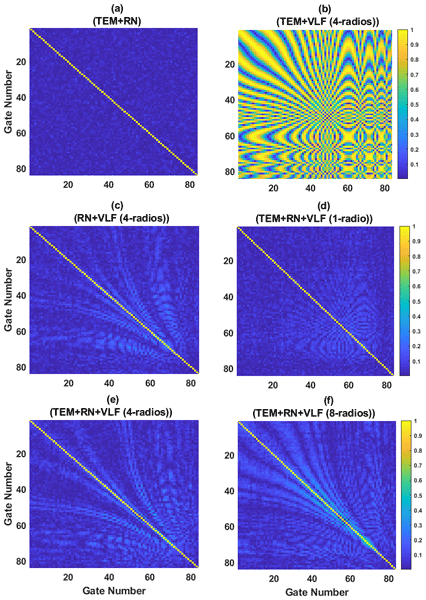
Data recorded with transient electromagnetics are typically gated to improve the signal-to-noise ratio. Gating corresponds to low-pass filtering of data with the shape of the gate giving the frequency response. We show that standard gate shapes can lead to significant correlation between gates caused by distortion from VLF radios. A multi-objective cost function is used to select optimum gate shapes with less influence from radio noise. Performance is demonstrated using synthetic and field data.
Derek McKay, Juha Vierinen, Antti Kero, and Noora Partamies
Geosci. Instrum. Method. Data Syst., 11, 25–35, https://doi.org/10.5194/gi-11-25-2022, https://doi.org/10.5194/gi-11-25-2022, 2022
Short summary
Short summary
When radio waves from our galaxy enter the Earth's atmosphere, they are absorbed by electrons in the upper atmosphere. It was thought that by measuring the amount of absorption, it would allow the height of these electrons in the atmosphere to be determined. If so, this would have significance for future instrument design. However, this paper demonstrates that it is not possible to do this, but it does explain how multiple-frequency measurements can nevertheless be useful.
Jakob Juul Larsen, Stine Søgaard Pedersen, Nikolaj Foged, and Esben Auken
Geosci. Instrum. Method. Data Syst., 10, 81–90, https://doi.org/10.5194/gi-10-81-2021, https://doi.org/10.5194/gi-10-81-2021, 2021
Short summary
Short summary
The transient electromagnetic method (TEM) is widely used for mapping subsurface resistivity structures, but data are inevitably contaminated by noise from various sources including radio signals in the very low frequency (VLF) 3–30 kHz band. We present an approach where VLF noise is effectively suppressed with a new post-processing scheme where boxcar gates are combined into semi-tapered gates. The result is a 20 % increase in the depth of investigation for the presented test survey.
Simon Toepfer, Yasuhito Narita, Daniel Heyner, Patrick Kolhey, and Uwe Motschmann
Geosci. Instrum. Method. Data Syst., 9, 471–481, https://doi.org/10.5194/gi-9-471-2020, https://doi.org/10.5194/gi-9-471-2020, 2020
Short summary
Short summary
The Capon method serves as a powerful and robust data analysis tool when working on various kinds of ill-posed inverse problems. Besides the analysis of waves, the method can be used in a generalized way to compare actual measurements with theoretical models, such as Mercury's magnetic field analysis. In view to the BepiColombo mission this work establishes a mathematical basis for the application of Capon's method to analyze Mercury's internal magnetic field in a robust and manageable way.
Yuan Li, Song Gao, Saimin Zhang, Hu He, Pengfei Xian, and Chunmei Yuan
Geosci. Instrum. Method. Data Syst., 9, 443–450, https://doi.org/10.5194/gi-9-443-2020, https://doi.org/10.5194/gi-9-443-2020, 2020
Short summary
Short summary
The baseline wander has special characteristics, such as being low frequency, large amplitude, non-periodic, and non-stationary. It is caused by the receiving coil motion and always exists in the process of data acquisition. The proposed method can be used to solve similar problems. This paper has the following highlights: (1) the method can be used to process non-periodic and non-stationary signals; (2) the method is adaptive to satisfy the stopping criterion based on the measured signal.
Mauro Regi, Paolo Bagiacchi, Domenico Di Mauro, Stefania Lepidi, and Lili Cafarella
Geosci. Instrum. Method. Data Syst., 9, 105–115, https://doi.org/10.5194/gi-9-105-2020, https://doi.org/10.5194/gi-9-105-2020, 2020
Short summary
Short summary
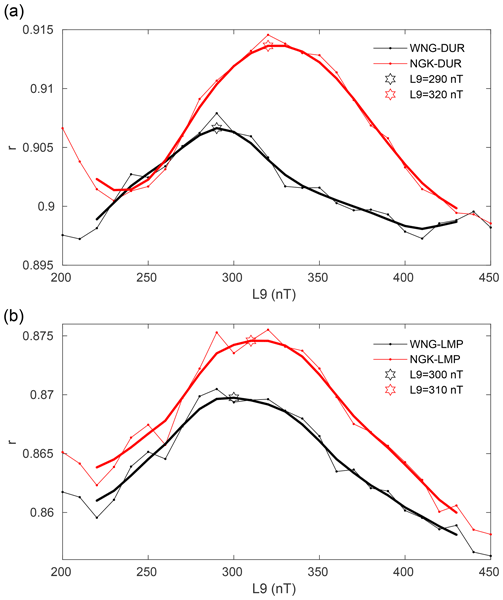
The K index, characterizing local geomagnetic activity, is generally automatically calculated by algorithms such as KASM, one of the four software programs recommended by INTERMAGNET. KASM requires an appropriate L9 value. We analyze K values for Italian observatories and compare them with historical German observatories to establish the best L9 estimation for our stations. A comparison with results from a previous empirical method shows the consistency and reliability of our outcome.
Shuhan Li, Qisheng Zhang, Xiao Zhao, Shenghui Liu, Zhenzhong Yuan, and Xinyue Zhang
Geosci. Instrum. Method. Data Syst., 6, 263–267, https://doi.org/10.5194/gi-6-263-2017, https://doi.org/10.5194/gi-6-263-2017, 2017
Short summary
Short summary
The main contribution of our paper is the proposal of a dynamic data transmission technology of an expendable current profiler, using varnished wires as the data transmission medium. The results of both indoor and marine tests demonstrate high efficiency and accuracy for transmission distances up to 2 km. We believe that this study will be of interest to the readership because our research is of particular interest and use for scientific marine investigation.
Arvind Singh and Upendra Kumar Singh
Geosci. Instrum. Method. Data Syst., 6, 53–69, https://doi.org/10.5194/gi-6-53-2017, https://doi.org/10.5194/gi-6-53-2017, 2017
Short summary
Short summary
Presented work allows estimation of buried source without any prior knowledge of underlying formation. This paper deals the application of continuous wavelet transform (CWT) and Euler deconvolution methods to estimate the source depth using magnetic anomalies. These methods are utilized mainly to focus on the fundamental issue for mapping the major coal seam and locating magnetic lineaments over Jharia coalfield, India.
K. Jourde, D. Gibert, and J. Marteau
Geosci. Instrum. Method. Data Syst., 4, 177–188, https://doi.org/10.5194/gi-4-177-2015, https://doi.org/10.5194/gi-4-177-2015, 2015
Short summary
Short summary
This paper examines how the resolution of small-scale geological density models is improved through the fusion of information provided by gravity measurements and density muon radiographies. The method is illustrated with examples for the La Soufrière volcano of Guadeloupe.
O. W. Roberts, X. Li, and L. Jeska
Geosci. Instrum. Method. Data Syst., 3, 247–254, https://doi.org/10.5194/gi-3-247-2014, https://doi.org/10.5194/gi-3-247-2014, 2014
Cited articles
Agricola, T.: Großskalige 3D-Geoelektrik im Hohen Vogelsberg und auf dem Seeboden der Kinzigtalsperre (Large-scale 3D geoelectrics in the High Vogelsberg and on the lake bottom of the Kinzig dam), Diss. Johann Wolfgang Goethe-Universität Frankfurt am Main, urn:nbn:de:hebis:30:3-443077, 2016.
Albertini, A. and Kleemann, W.: Analogue and digital Lock-In techniques for very-low-frequency impedance spectroscopy, Meas. Sci. Technol., 8, 666–672, 1997.
Alfano, L.: A modified geoelectrical procedure using polar-dipole arrays – an example of application to deep exploration, Geophys. Prospect. 22, 510–525, 1974.
Alfano, L.: Dipole–dipole deep geoelectrical soundings over geological structures, Geophys. Prospect. 28, 283–296, 1980.
Andersson, M., Persson, L., Svensson, T., and Svanberg, S.: Flexible Lock-In detection system based on synchronized computer plug-in boards applied in sensitive gas spectroscopy, Rev. Sci. Instrum., 78, https://doi.org/10.1063/1.2813346, 2007.
Baker, E. B.: RF Phase-Sensitive Detector for Nuclear Magnetic Resonance Signals, Rev. Sci. Instrum., 25, 390–391, 1954.
Balasco, M., Galli, P., Giocoli, A., Gueguen, E., Lapenna, V., Perrone, A., Piscitelli, S., Rizzo, E., Romano, G., Siniscalchi, A., and Votta, M.: Deep geophysical electromagnetic section across the middle Aterno Valley (central Italy): preliminary results after the April 6, 2009 L'Aquila earthquake, B. Geofis. Teor. Appl., 52, 443–455, https://doi.org/10.4430/bgta0028, 2011.
Bengtsson, L. E.: A microcontroller-based Lock-In amplifier for sub-milliohm resistance measurements, Rev. Sci. Instrum., 83, https://doi.org/10.1063/1.4731683, 2012.
Bergmann, P., Schmidt-Hattenberger, C., Kiessling, D., Rücker, C., Labitzke, T., Henninges, J., Baumann, G., and Schütt, H.: Surface-downhole electrical resistivity tomography applied to monitoring of CO2 storage at Ketzin, Germany, Geophysics, 77, B253–B267, 2012.
Blair, D. P. and Sydenham, P. H.: Phase sensitive detection as a means to recover signals buried in noise, J. Phys. E Sci. Instrum., 8, 621–627, 1975.
Brunner, I., Friedel, S., Jacobs, F., and Danckwardt, E.: Investigation of a Tertiary maar structure using three-dimensional resistivity imaging, Geophys. J. Int., 136, 771–780, 1999.
Caracappa, A. and Thorn, C.: Target Polarization Measurements with a Crossed-Coil NMR Polarimeter, in: AIP conference proceedings, Institute of Physics (IOP) Publishing Ltd., 867–871, 2003.
Colella, A., Lapenna, V., and Rizzo, E.: High-resolution imaging of the High Agri Valley basin (Southern Italy) with Electrical Resistivity Tomography, Tectonophysics, 386, 29–40, 2004.
De Marcellis, A., Ferri, G., D'Amico, A., Natale, C. D., and Martinelli, E.: A fully-analog Lock-In amplifier with automatic phase alignment for accurate measurements of ppb gas concentrations, IEEE Sens. J., 12, 1377–1383, 2012.
Dereppe, J. M.: Phase Sensitive Detector, Rev. Sci. Instrum., 32, 979–979, 1961.
Ferri, G., De Laurentiis, P., D'Amico, A., and Di Natale, C.: A low-voltage integrated CMOS analog Lock-In amplifier prototype for LAPS applications, Sensor. Actuator., 92, 263–272, 2001.
Flechsig, C., Fabig, T., Rücker, C. and Schütze, C.: Geoelectrical Investigations in the Cheb Basin/W-Bohemia: An Approach to Evaluate the Near-Surface conductivity structure, Stud. Geophys. Geod., 54 , 417–437, 2010.
Friedel, S.: Über die Abbildungseigenschaften der geoelektrischen Impedanztomographie unter Berücksichtigung von endlicher Anzahl und unendlicher Genauigkeit der Meßdaten, (“Imaging properties of geoelectric impedance tomography taking into account a finite number of limited accuracy measurements”), Shaker Verlag, Aachen, ISBN 3-8265-7587-3, 2000 (in German).
Gabal, M., Medrano, N., Calvo, B., Martínez, P. A., Celma, S., and Valero, M. R.: A complete low voltage analog Lock-In amplifier to recover sensor signals buried in noise for embedded applications, Procedia Engineer., 5, 74–77, 2010.
Golden, S., Roßberg, R., and Junge, A.: The data logger Geolore and its application in lake bottom magnetotellurics, in: 17th workshop on electromagnetic induction in the earth, Hyderabad, India, 2004.
Günther, T., Musmann, P., Schaumann, G., and Grinat, M.: Imaging of a fault zone by a large-scale dc resistivity experiment and seismic structural information, Ext. abstr., 17th EAGE Near Surface, Leicester, UK, 2011.
Günther, T., Ronczka, M., and Voß, T.: Saltwater Monitoring Using Long-Electrode ERT, in: Geological Storage of CO2 – Long Term Security Aspects, edited by: Liebscher, A. and Münch, U., Springer Int. Publ., 167–182, https://doi.org/10.1007/978-3-319-13930-2_8, 2015.
Holzman, J. F., Scollo, R., Lohe, H. J., Robin, F., Jäckel, H., and Erni, D.: Phase-sensitive Lock-In detection of semiconductor waveguide intensity profiles, Rev. Sci. Instrum., 76, https://doi.org/10.1063/1.2126810, 2005.
Johnson, S. L., Thomas, M. V., and Kros, C. J.: Membrane capacitance measurement using patch clamp with integrated self-balancing Lock-In amplifier, Pflü. Arch., 443, 653–663, 2002.
Masciotti, J. M., Lasker, J. M., and Hielscher, A. H.: Digital Lock-In detection for discriminating multiple modulation frequencies with high accuracy and computational efficiency, IEEE T. Instrum. Meas., 57, 182–189, 2008.
Meade, M. L.: Advances in Lock-In amplifiers, J. Phys. E Sci. Instrum., 15, 395–403, 1982.
Meade, M. L.: Lock-In amplifiers: principles and applications (No. 1), Inst. of Engineering and Technology, 1983.
Murányi, F., Simon, F., Fülöp, F., and Jánossy, A.: A longitudinally detected high-field ESR spectrometer for the measurement of spin–lattice relaxation times, J. Magn. Reson., 167, 221–227, 2004.
Naess, O. E. and Bruland, L.: Stacking methods other than simple summation, Developments in Geophysical Exploration Methods, 6, 189–223, 1985.
Oppermann, F. and Günther, T.: Codes and data for Software lock-in processing, Zenodo, https://doi.org/10.5281/zenodo.1167654, 2018.
Pribnow, D. F., Schütze, C., Hurter, S. J., Flechsig, C. and Sass, J. H.: Fluid flow in the resurgent dome of Long Valley Caldera: implications from thermal data and deep electrical sounding, J. Volcanol. Geoth. Res., 127, 329–345, 2003.
Proksch, R.: Multifrequency, repulsive-mode amplitude-modulated atomic force microscopy, Appl. Phys. Lett., 89, https://doi.org/10.1063/1.2345593, 2006.
Rizzo, E., Colella, A., Lapenna, V., and Piscitelli, S.: High-resolution images of the fault controlled High Agri Valley basin (Southern Italy) with deep and shallow Electrical Resistivity Tomographies, Phys. Chem. Earth, 29, 321–327, 2004.
Ronczka, M.: Saltwater detection and monitoring using metal cased boreholes as long electrodes, PhD thesis, TU Berlin, https://doi.org/10.14279/depositonce-5131, 2015.
Roßberg, R.: Geolore: Migration from an experiment to a versatile instrument, Proceedings of the 22nd Colloquium Electromagnetic Depth Research, Décin, CR, available at: http://bib.gfz-potsdam.de/emtf/2007/ (last access: 2 February 2018), 2007.
Saam, B. T. and Conradi, M. S.: Low frequency NMR polarimeter for hyperpolarized gases, J. Magn. Reson., 134, 67–71, 1998.
Santilano, A., Godio, A., Manzella, A., Menghini, A., Rizzo, E., and Romano, G.: Electromagnetic and DC methods for geothermal exploration in Italy, state-of-the-art, case studies and future developments, First Break, 33, 81–86, 2015.
Scofield, J. H.: Frequency-domain description of a Lock-In amplifier, Am. J. Phys., 62, 129–132, 1994.
Schünemann, J., Günther, T., and Junge, A.: 3-dimensional subsurface investigation by means of large-scale tensor-type dc resistivity measurements, Ext. abstract, 4th International Symposium on Three-Dimensional Electromagnetics, Freiberg, 2007.
Schütze, C. and Flechsig, C.: Structural investigations of an active hydrothermal system beneath the Long Valley caldera, California, using DC-resistivity imaging methods, Z. Geol. Wissenschaft, 30, 119–129, 2002.
Sonnaillon, M. O. and Bonetto, F. J.: A low-cost, high-performance, digital signal processor-based Lock-In amplifier capable of measuring multiple frequency sweeps simultaneously, Rev. Sci. Instrum., 76, https://doi.org/10.1063/1.1854196, 2005.
Storz, H., Storz, W., and Jacobs, F.: Electrical resistivity tomography to investigate geological structures of the earth's upper crust, Geophys. Prospect., 48, 455–471, 2000.
Surkov, V. V. and Hayakawa, M.: ULF electromagnetic noise due to random variations of background atmospheric current and conductivity, J. Geophys. Res., 112, D11116, https://doi.org/10.1029/2006JD007788, 2007.
Tamburriello, G., Balasco, M., Rizzo, E., Harabaglia, P., Lapenna, V., and Siniscalchi, A.: Deep electrical resistivity tomography and geothermal analysis of Bradano foredeep deposits in Venosa area (Southern Italy): first results, Ann. Geophys., 51, 203–212, 2008.
Udphuay, S., Günther, T., Everett, M. E., Warden, R. R., and Briaud, J.-L.: Three-dimensional resistivity tomography in extreme coastal terrain amidst dense cultural signals: application to cliff stability assessment at the historic D-Day site, Geophys. J. Int., 185, 201–220, 2011.
Vistnes, A. I., Wormald, D. I., Isachsen, S., and Schmalbein, D.: An efficient digital phase-sensitive detector for use in electron-spin-resonance spectroscopy, Rev. Sci. Instrum., 55, 527–532, 1984.
Wilson, J. W., Park, J. K., Warren, W. S., and Fischer, M. C.: Flexible digital signal processing architecture for narrowband and spread-spectrum Lock-In detection in multiphoton microscopy and time-resolved spectroscopy, Rev. Sci. Instrum., 86, https://doi.org/10.1063/1.4916261, 2015.
Short summary
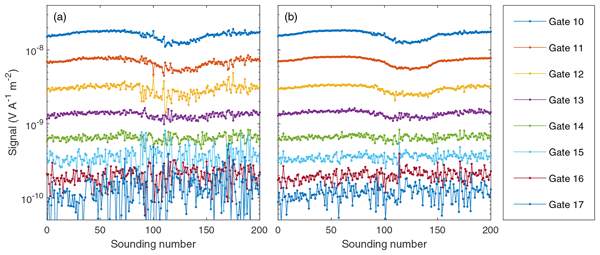
We present a new versatile datalogger that can be used remotely for a wide range of applications in geosciences such as environmental and groundwater monitoring or in applied geophysics. The recorded signals will be processed using a new software approach, which will improve the data quality for very poor signal-to-noise ratios. We show this improvement by comparing it with traditional software-algorithm-processing synthetic data sets and real data collected in the field.
We present a new versatile datalogger that can be used remotely for a wide range of applications...